Optimizing Your Home Care Agency Marketing for 2026
Build a modern, scalable growth engine that converts intent into lifetime clients.

Sage Care Editorial
Content & Communications Team

The most successful home care business operators in 2026 will treat marketing like a system, not a series of one-offs. That means connecting demand generation, intake, and operations so families move from first touch to care plan without friction. With AI technology in home care now mainstream, agencies can finally measure what works, personalize at scale, and automate the busywork that stalls growth.
Below is a clear, practical blueprint to modernize your home care marketing and win in 2026.
Match Your Market: Intent, Messaging, and Positioning
Most agencies compete on the same four points: compassion, reliability, trust, and quality. These matter, but they do not differentiate. Build your positioning around specific needs and outcomes.
Intent signals: Use search data to map real family language. Queries like “in-home care for dementia,” “respite care near me,” or “post-surgery home support” reveal urgency and service expectations. Align your pages and campaigns to those phrases, not generic terms.
Outcomes over features: Lead with the result families want. “Keep mom safely at home,” “Reduce hospital readmissions,” “Support family caregivers with reliable respite.” Then substantiate with care protocols, training, and quality metrics.
Local relevance: Families choose trusted local providers. Anchor your messaging in neighborhoods, hospitals, physician groups, and senior centers you serve. Add testimonials that read like real-life stories, not polished slogans.
This clarity drives both conversion and referral confidence.
Build a High-Performing Website That Converts
Your website is your primary storefront. Treat it like an intake tool, not a brochure.
Service-specific landing pages: For every core service, publish a page with symptoms and signs that trigger care, how your team helps, proof points, and a clear next step. This lifts SEO performance for home care marketing and increases relevance.
Real accessibility: Phone number visible on mobile, tap-to-call, short contact forms with only essential fields, live chat, and a clear timeline of what happens next. Families need quick clarity, not long forms.
Trust and proof: Add transparent pricing ranges, caregiver credentials, clinical affiliations where applicable, and plain-language quality metrics. Include compliance statements and HIPAA practices to reassure digital-first families.
Pair this with structured data for local SEO and speed optimizations. Search engines reward fast, clear sites.
Turn Calls Into Clients With Intake Automation
Marketing succeeds when intake is fast, accurate, and empathetic. Sage was designed to remove the friction that costs you conversions.
Automate call recording, transcription, and summarization so your team never has to take notes while listening. This improves empathy and accuracy on every call.
Generate instant, personalized follow ups that are ready to send before you hang up. Speed matters; families respond to the agency that provides timely clarity.
Populate draft care plans based on call data so coordinators start from a strong baseline. This accelerates scheduling and creates professional consistency.
Sync directly with your existing agency management system (e.g., Wellsky) to keep data tidy and actionable without extra manual entry.
With Sage, agencies save up to 100 minutes per prospective client, freeing staff to focus on care and connection — not paperwork. When marketing and intake operate as one, conversion rates rise.
Make Paid Media Work Harder
In 2026, paid media must be accountable. Tie spend to outcomes you control.
Search ads: Bid on high-intent queries that match your service pages. Use call-only formats during peak hours so families reach a person fast. Rotate ad copy by seasonality and clinical partners.
Local listings and maps: Treat Google Business Profiles like living assets. Post weekly updates, add new photos, respond to reviews, and set accurate service attributes. This is often the first impression.
Remarketing: Many families research over multiple sessions. Use remarketing to bring them back to a service page or a short guided intake form. Keep the frequency sane and the message supportive.
Measure fully loaded CAC, not just media CPCs. The goal is predictable client acquisition, not vanity metrics.
Win Referral Relationships Without the Backlog
Physicians, discharge planners, therapists, and senior centers are still powerful channels. The barrier is follow-through.
Fast handoffs: When a referral arrives, ensure immediate acknowledgement and a specific timeline. With AI technology in home care intake, the follow up can be instant and personalized.
Feedback loops: Send brief outcomes summaries to referrers. Show how their recommendation led to safe care at home and reduced readmissions. This builds trust.
Focused collateral: Create one-page summaries for each service line that match clinician language. Include coverage areas, scheduling timelines, and contact pathways.
Referrers reward agencies that make them look good and reduce friction for their patients. Head to our article on building winning referral strategies here.
Content That Families Actually Use
Publish content that solves real problems, not filler.
Decision guides: “How to choose a home care provider,” “Questions to ask before hiring,” “Home safety checklist after hospital discharge.” These build authority and help families act.
Condition-specific care: Explain best practices for dementia, Parkinson’s, post-orthopedic surgery, cardiovascular recovery, and caregiver respite. Include training standards and safety protocols.
Local resources: Curate community services, support groups, and transportation options. When you help families navigate, you earn trust before the sale.
Use simple language and scannable formats. This is how home care software and thoughtful publishing join to drive conversion.
Measure What Matters and Optimize Weekly
Operate a tight loop from marketing to intake to scheduling.
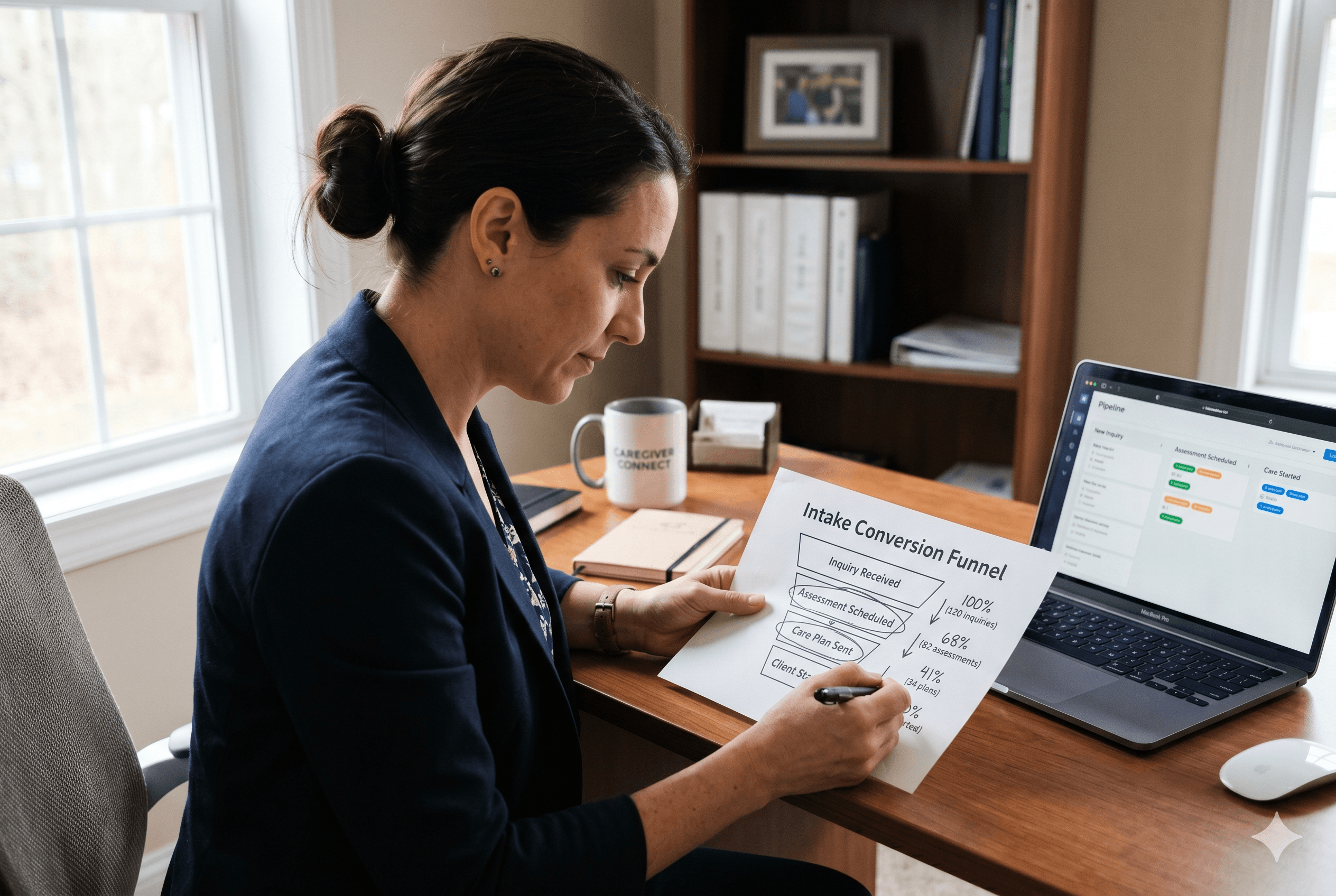
Core metrics: Inquiry volume by channel, answered call rate, time to first response, scheduled assessment rate, start-of-care lag, and caregiver match quality. Quality improves when data flows end to end.
Attribution: Track which page or ad led to the call, which intent and condition drove the need, and which follow up converted. Sage’s summaries and synced data make this attribution real, not guesswork.
Continuous improvement: Every week, update one landing page, one ad group, and one intake script. Small, consistent changes compound.
High-performing agencies treat growth like operations. The result is a predictable pipeline and calmer staffing. For more on KPIs in home care, head to our blog here.
Operational Readiness Drives Marketing ROI
Growth puts stress on scheduling, caregiver availability, and quality assurance. Plan for success.
Capacity signals: Display current availability windows and service areas clearly. Set expectations about start-of-care timelines.
Caregiver readiness: Align recruitment campaigns with marketing forecasts. When demand rises, your bench needs to be ready.
Consistency: Standardize scripts, documentation, and safety checks. AI-assisted summaries and care plan drafts help every coordinator deliver the same experience.
Families feel consistency. Referrers notice it. Staff thrive in it.
The 2026 Advantage: Human-Centered, AI-Powered
The agencies that win in 2026 integrate human empathy with intelligent systems. You attract families with clear messaging, convert them through thoughtful intake, and serve them with reliable care. AI technology in home care does not replace your team — it removes the busywork so your people can do their best work.
If you want your marketing to produce dependable growth, connect the dots: positioning, website conversion, paid and referral channels, intake automation, and operational readiness. This is the system that compounds.
To see how Sage can streamline intake, speed follow ups, and keep your systems in sync, schedule a demo today to learn more about how Sage can help you grow your business.