The Small Agency's Guide to Competing With Home Care Franchises Online
Small agencies can beat franchises online. Here is exactly where the opportunity is and how to take it.

Jon Levinson
CEO & Co-Founder, Sage

Home care franchises have real advantages online. They have national SEO budgets, professionally built websites, and marketing teams running paid campaigns in your local market. For a small independent agency, looking at that and concluding you cannot compete is understandable. It is also wrong.
This guide covers where those weaknesses are and how to exploit them through home care digital marketing that is realistic for a one or two-person operation. If you are still building out your broader marketing approach, a full breakdown of home care marketing channels and how to prioritize them is a useful companion to this post.
Where Franchises Have the Advantage Online
Being honest about where you are outgunned is the starting point for a smarter strategy. Franchises typically win in:
Paid search. National brands run Google Ads campaigns with large budgets and dedicated PPC managers. Bidding against them on broad terms like "home care agency" is expensive and usually not worth it for a small agency.
Domain authority. Franchise parent sites have years of backlinks and high domain authority, which helps them rank for competitive national keywords.
Brand recognition in reviews. Well-known franchise names carry name recognition that new agencies have not yet built.
Knowing this tells you exactly where not to compete. Fighting franchises on their terms, broad keywords and paid volume, is a losing strategy for most small agencies. The opportunity is in the places they cannot go.
Where Small Agencies Have the Advantage Online
Hyper-Local Search
Franchises are optimized for scale. Their websites speak to broad geographies, and their content is often templated across dozens of locations. That creates a genuine gap at the hyper-local level.
A family searching "home care for elderly parents in [your neighborhood]" or "in-home care near [local hospital name]" is looking for something that feels close and specific. A local independent agency with a well-maintained Google Business Profile, neighborhood-specific content, and genuine local reviews will consistently outrank a franchise location page that was templated from a national site.
This is the single most actionable advantage small agencies have in home care digital marketing. Own your geography at the street level before worrying about anything else.
Authentic Reviews
Franchise locations collect reviews across dozens of markets with varying quality. A small agency with 25 recent, detailed, genuine Google reviews from local families often outperforms a franchise with 200 reviews spread across multiple years and locations.
According to Sage Care's survey of 500-plus home care consumers, 51% say they trust Google reviews above any other source when evaluating a home care agency. Reviews are not supplementary to your digital marketing. They are the core of it for a small agency competing locally.
The agencies that win on reviews are not doing anything complicated. They ask at the right moment, make the process easy, and respond to every review publicly. That consistency compounds over time in a way that a franchise with centralized marketing rarely replicates at the local level.
Specific, Helpful Content
Franchises publish content at scale, which usually means it is generic. A blog post that reads as if it could apply to any city in any state is not particularly useful to a family in your market making a real decision.
Small agencies can publish content that is specific to their community: local resources for aging adults, guides to navigating care options in their county, answers to questions their actual clients have asked. That specificity is rewarded by Google because it is more useful to the reader, and it is rewarded by families because it signals that you understand their situation.
Knowing which topics families are actually searching for in your market is the starting point. The blog topics that generate real home care inquiries tend to cluster around costs, care options, and what to expect during the intake process, not the broad informational content that franchise sites are full of.
A Practical Home Care Digital Marketing Plan for Small Agencies
Start With Your Google Business Profile
This is the single highest-return investment in home care digital marketing for a local agency. A complete, active Google Business Profile with accurate hours, service descriptions, photos, and a steady stream of reviews will drive more local inquiries than almost any other activity.
Make sure your profile includes:
Your exact service area, listed by neighborhood or zip code where possible
A clear description of the types of care you provide
Updated photos of your team and office, not stock images
A response to every review, positive or critical
Check it monthly. Franchises often neglect individual location profiles because managing them at scale is difficult. That neglect is your opportunity.
Build Neighborhood-Level Content
Pick three to five neighborhoods or zip codes within your service area and create a simple page or blog post for each one. The content does not need to be long. It needs to be specific: local senior resources, nearby hospitals or rehab facilities you work with, and a clear explanation of your services in that area.
These pages rank for searches that franchise sites will never bother to target. Over time they become a steady source of local organic traffic that does not cost anything to maintain once it is built.
Use Content to Answer Real Questions
Families searching for home care are not looking for agency profiles. They are looking for answers to questions they are afraid to ask out loud: how much does this cost, how do I know if my parent needs help, what happens if I do not like the caregiver assigned.
Build content around those questions. A small agency that consistently publishes honest, specific answers to real family concerns builds a level of credibility online that no franchise template can replicate.
Consumer research consistently highlights that families make their agency choice based heavily on which provider makes them feel most informed and least anxious during the search process.
Make Your Website Do Sales Work
Most small agency websites are digital brochures. A franchise site, for all its generic content, at least has a clear call to action on every page. Match that minimum and then go further.
Your website should include:
A general pricing range, even if approximate. Ninety-one percent of families say this is important before they contact an agency
A simple contact form that takes under two minutes to complete
A short explanation of what happens after someone reaches out, step by step
At least one real client story or testimonial, not a placeholder quote
These are not design decisions. They are conversion decisions. A family who lands on your site and cannot find pricing, cannot quickly understand your process, or cannot see evidence that real families have used you, will click away to the franchise site that at least answers those questions.
How Responsiveness Becomes a Digital Marketing Advantage
Here is something most agencies miss when thinking about home care digital marketing: what happens after someone contacts you is part of your marketing.
Families evaluate your agency based on how you respond to their first inquiry as much as what your website says. A franchise with a national intake team may respond quickly. Many franchise locations, however, run on the same lean staffing model as independent agencies and respond just as slowly.
If your agency responds to every inquiry within 30 to 60 minutes with a personalized, professional follow-up, you are already ahead of most of the competition, franchise or otherwise. That responsiveness also drives the reviews and word-of-mouth that fuel your organic rankings over time.
Sage Care is built specifically for this
After every call or in-home assessment, the AI generates a structured summary and a draft follow-up email that the operator reviews and sends in under five minutes. For a solo operator competing against a franchise with a dedicated intake coordinator, that speed and consistency is a genuine equalizer.
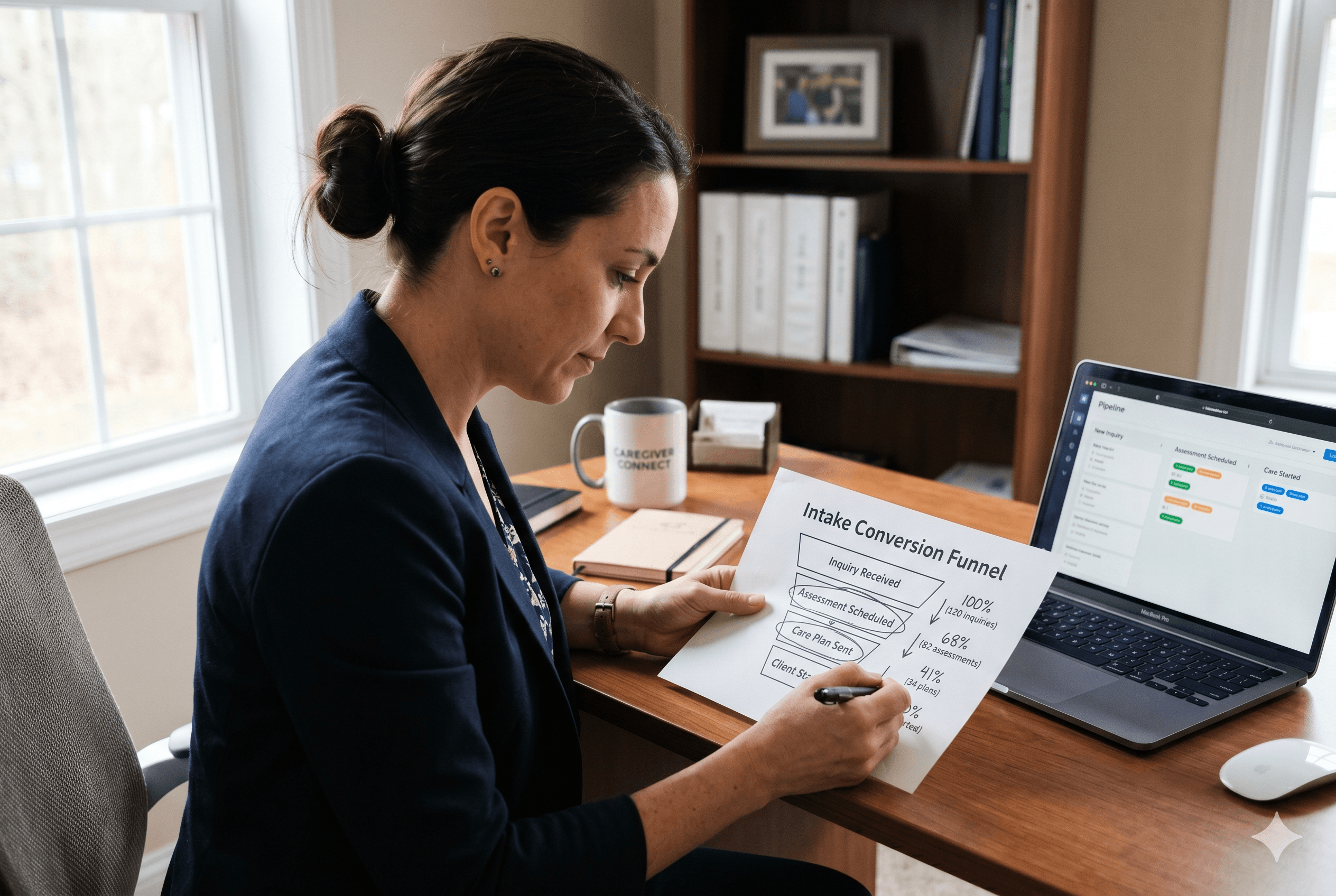
To read more about how agencies structure their full client acquisition process from first contact through to signed care plan, this guide on building an intake workflow that converts covers each stage in practical detail.
Putting It Into Practice
Competing with home care franchises online is not about matching their budget. It is about being more specific, more local, and more responsive than a templated national operation can be. Those are advantages that belong to small agencies by default. The question is whether you use them deliberately.
Own your geography on Google. Collect reviews consistently. Publish content that answers real questions. Respond to every inquiry faster than the competition. Done consistently, those four things will outperform a franchise marketing budget in your local market.
If you want to see how Sage Care helps small agencies stay responsive and professional without adding headcount, schedule a demo. The 30-day free trial is a no-commitment way to see what a faster, more consistent intake process does to your conversion rate.
Frequently Asked Questions
Can a small home care agency realistically outrank a franchise on Google?
Yes, specifically for local and neighborhood-level searches. Franchises are optimized for scale, not local specificity. That gap is where independent agencies win.
What is the most cost-effective home care digital marketing strategy for a small agency?
A complete Google Business Profile combined with consistent review collection and one to two pieces of local content per month delivers the highest return for the lowest ongoing investment.
Do I need to run paid ads to compete with franchise agencies online?
Not necessarily. Paid ads are expensive and competitive on broad terms. Organic local SEO and content marketing often outperform paid for small agencies in their specific geography.