
Home Care Lead Conversion Rate: What's "Good" and How to Get There
What a good home care lead conversion rate looks like, and the four levers that move it up.

Sage Care Editorial
Content & Communications Team
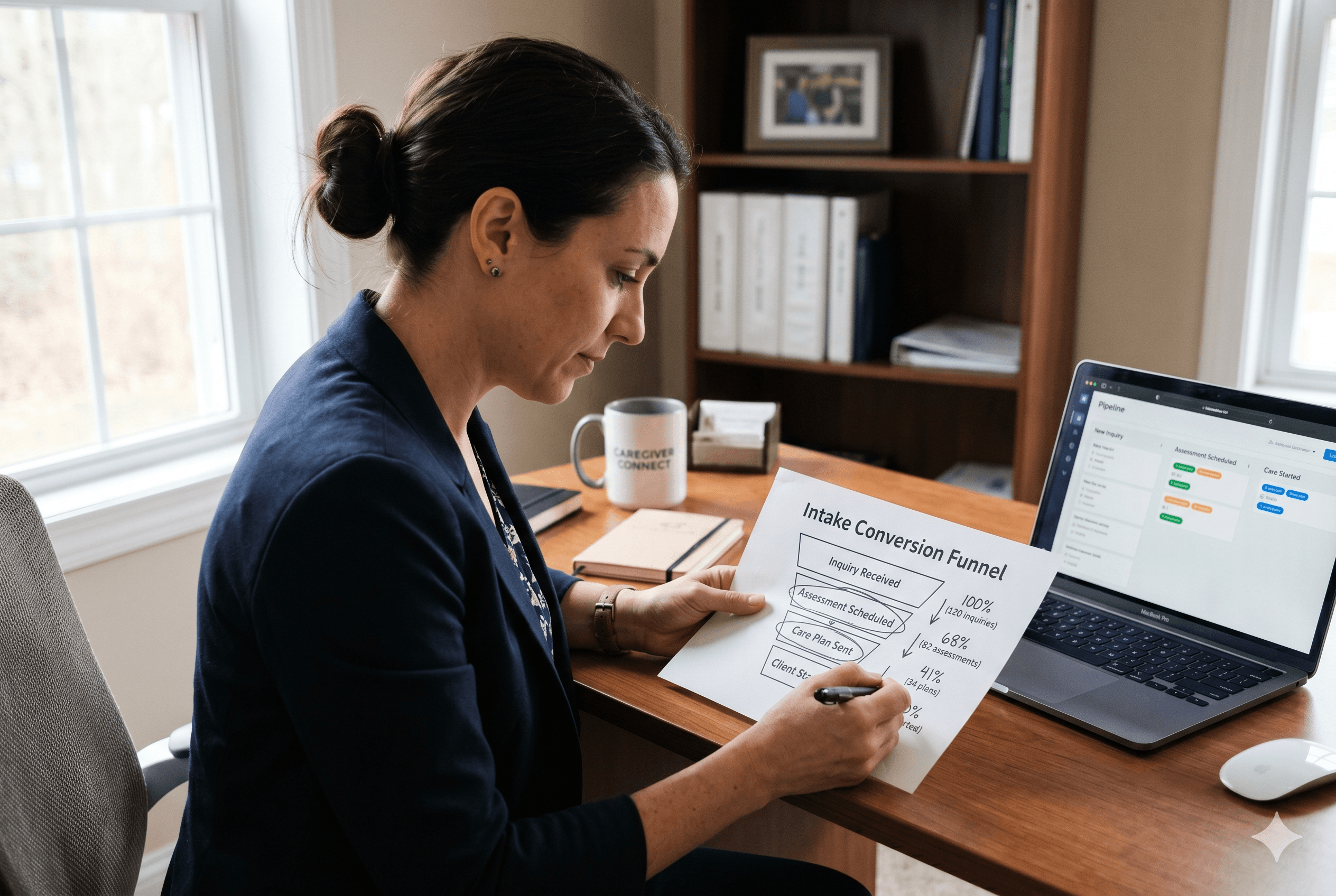
Most home care agency owners focus on generating more leads when conversion is the actual constraint. More inquiries flowing into a leaky intake process does not produce more clients. It produces more wasted effort and a higher cost per acquisition.
Understanding what a good conversion rate looks like for a home care agency, and knowing which specific factors move it, is more valuable than any lead generation tactic. This post covers both: the benchmarks that tell you where you stand, and the levers that reliably improve where you end up.
What "Lead Conversion" Actually Means in Home Care
Home care lead conversion is not a single number. It is a chain of smaller conversions, each one dependent on the step before it. The chain typically looks like this:
Inquiry received → Follow-up made → Assessment scheduled → Assessment completed → Care plan sent → Client started
A conversion rate problem can live at any of those transitions. An agency with a strong inquiry-to-assessment rate but a weak assessment-to-start rate has a different problem than one that is losing leads between follow-up and scheduling. Knowing where in the chain the drop-off is happening tells you exactly where to focus.
The overall inquiry-to-client conversion rate is the number most agencies want to benchmark, but it is the stage-by-stage view that actually tells you what to fix.
Conversion Rate Benchmarks for Home Care Agencies
These benchmarks reflect what agencies with structured intake processes typically achieve. Agencies without a defined intake process often fall significantly below these ranges.
Intake Stage | Below Average | Average | Strong |
|---|---|---|---|
Inquiry to follow-up within 1 hour | Below 40% | 40-65% | Above 80% |
Inquiry to assessment scheduled | Below 30% | 30-50% | Above 60% |
Assessment to care plan sent within 48 hours | Below 40% | 40-60% | Above 75% |
Assessment to client started | Below 45% | 45-65% | Above 75% |
Overall inquiry to client started | Below 15% | 15-30% | Above 35% |
A few things worth noting about these numbers:
Agencies in highly competitive urban markets tend to have lower inquiry-to-assessment rates because families are simultaneously evaluating more options
Agencies with strong referral source relationships tend to have higher assessment-to-start rates because referred families arrive with more trust already established
The overall inquiry-to-client rate of 35% or above is achievable for small agencies with structured intake processes, but rare for agencies relying on manual tracking and ad hoc follow-up
The Four Levers That Move Conversion Rate
Lever 1: Response Time
Response time is the single factor with the most direct impact on whether an inquiry converts to an assessment. The data on this is clear and consistent.
According to Sage Care's survey of 500-plus home care consumers, 81% of families expect a response within one hour of their initial inquiry, and 41% expect one within 15 minutes. What home care consumers actually want from the agencies they contact puts responsiveness alongside price as one of the top three deciding factors in the final choice.
The competitive reality is stark. Sage Care's cold-call research across 50-plus agencies found that only 37% answered their phone live during business hours, and 22% of agencies that went to voicemail never called back at all. An agency that responds within 30 minutes to every inquiry is already ahead of the majority of its local competition before the conversation even begins.
Every hour of delay between an inquiry and a first response reduces the probability of that inquiry converting. The drop-off is steepest in the first two hours. Agencies that respond within 30 minutes convert at roughly twice the rate of agencies that respond the following day.
What to do:
Set a target response time of 30 minutes during business hours
Build a system that notifies the right person the moment an inquiry comes in
If live answer is not possible, set a voicemail that gives the caller a specific callback time and meets that commitment
Lever 2: Follow-Up Cadence After First Contact
The first follow-up is not the last one. Most families do not commit after a single conversation. They need a clear next step, a consistent touchpoint schedule, and the confidence that comes from an agency that stays engaged without being pushy.
A practical follow-up cadence for an unscheduled lead looks like this:
Day | Action |
|---|---|
Day 0 | First call or inquiry received, follow-up email sent same day |
Day 1 | Check-in call if assessment not yet scheduled |
Day 3 | Second follow-up if no response, offer a specific assessment time |
Day 7 | Final follow-up with a clear close or nurture path |
The agencies that convert the highest percentage of inquiries are not the ones that follow up most aggressively. They are the ones that follow up most consistently, with a clear next step offered at each touchpoint rather than a generic "just checking in."
Documenting this cadence and making it a system rather than a memory exercise is what separates agencies that convert consistently from those that convert based on how busy their week was.
Lever 3: In-Home Assessment Quality
The assessment is the highest-stakes touchpoint in the intake chain. A family that agrees to an in-home assessment is close to a decision. What happens during that visit, and immediately after it, determines whether they cross the line.
The assessment quality factors that most directly affect conversion:
Listening before prescribing. Families who feel that the assessor genuinely understood their situation before proposing a care plan convert at higher rates than those who felt they received a generic pitch
Managing family dynamics. In-home assessments often involve multiple family members with different concerns. The assessor who addresses each perspective without letting the conversation become adversarial is the one who closes
Setting clear expectations. Families who leave the assessment knowing exactly what happens next, when they will receive the care plan, and when care could start, are less likely to go cold in the days that follow
Lever 4: Care Plan Speed and Quality
The gap between a completed assessment and a signed service agreement is where many agencies lose clients they should have converted. The assessment went well. The family was interested. But the care plan took five days to arrive, the follow-up was generic, and by the time the paperwork was ready another agency had already started care.
Care plan turnaround time is a conversion lever most agencies underestimate. Families arranging care for an aging parent are managing urgency alongside uncertainty. A professional care plan that arrives within 24 to 48 hours of the assessment signals that your agency is organized and ready to start.
Streamlining home care client acquisition with AI covers how the full process from click to care plan can run without the documentation delays that give families time to choose a faster competitor.
What Kills Conversion Rates in Small Agencies
Understanding what moves conversion up is only half of the equation. These are the most common conversion killers in small home care agencies:
No structured follow-up process.
When follow-up depends on someone remembering to do it between other tasks, it becomes inconsistent. Inconsistent follow-up produces inconsistent conversion. The agencies with the highest conversion rates have a defined process that runs the same way for every inquiry regardless of how busy the week is.
Manual documentation delays.
Every hour spent writing up assessment notes, building a care plan from scratch, and drafting a follow-up email is an hour the family is sitting without a response. Agencies moving from spreadsheets to a home care CRM consistently report that removing the documentation bottleneck is the single change that most directly improves conversion speed.
No pipeline visibility.
Agencies that cannot tell you where each active lead stands cannot identify which ones are going cold and need a re-engagement touchpoint. Without pipeline visibility, follow-up is reactive rather than proactive, and leads fall through silently.
Assessments without a clear close.
An assessment that ends with "we will be in touch" rather than "here is what happens next and when" leaves the family without an anchor. The agencies that convert the highest percentage of assessments are the ones that end every visit with a specific commitment about the next step and a timeline.
How to Diagnose Your Own Conversion Problem
Before trying to fix conversion, you need to know where the drop-off is happening. A simple diagnostic:
Count every inquiry that came in last month
Of those, how many resulted in a scheduled assessment?
Of completed assessments, how many converted to a started client?
For the ones that did not convert at each stage, what was the documented reason?
If you cannot complete this diagnostic from your current system without reconstructing from memory, the first fix is not a conversion tactic. It is visibility. Revisiting your home care intake KPIs and setting up proper stage-by-stage tracking gives you the baseline to measure any improvement against.
How Sage Care Addresses Each Conversion Lever
Sage Care is built to move each of the four conversion levers directly:
Response time — Every inbound call is logged automatically through built-in VOIP on iOS. After each call, an AI-generated summary and draft follow-up email is ready to send in under five minutes, so the first follow-up goes out within the hour every time
Follow-up cadence — Every lead is tracked in a home care-specific pipeline with stage-by-stage visibility. Nothing falls through because the system surfaces what needs attention rather than relying on memory
Assessment documentation — After every in-home assessment, Sage Care's AI generates a structured summary capturing care needs, ADLs, IADLs, and next steps. What previously took 20 to 30 minutes takes under five
Care plan speed — Draft care plans generated from assessment data are ready for review and delivery within hours rather than days, closing the window in which a family might choose a faster competitor
The Bottom Line
Conversion rate is not a marketing problem. It is an operational one. The agencies that convert the highest percentage of inquiries into clients are not necessarily generating more leads or offering lower prices. They are responding faster, following up more consistently, and removing the documentation delays that give families time to choose someone else.
The four levers, response time, follow-up cadence, assessment quality, and care plan speed, are all within reach of a small agency without a large team or a large budget. What they require is a process that runs consistently rather than depending on one person's availability on any given day.
If you want to see what Sage Care does to each of those four levers for a home care agency like yours, schedule a demo. The 30-day free trial gives you enough runway to see the difference in your own conversion numbers before committing.
Frequently Asked Questions
What is a good lead conversion rate for home care?
A strong overall inquiry-to-client conversion rate for home care agencies with structured intake processes is 35% or above. Agencies without a defined intake process typically convert below 15%.
How do I improve my home care intake conversion rate?
Focus on four levers in order: response time, follow-up cadence, assessment quality, and care plan turnaround speed. Response time has the most immediate impact. Agencies that respond within 30 minutes convert at roughly twice the rate of those that respond the following day.
What KPIs should home care agencies track for intake performance?
Start with time to first response, inquiry-to-assessment conversion rate, assessment-to-start conversion rate, and care plan turnaround time. These four numbers tell you exactly where your pipeline is leaking and what to fix first.