Home Care SEO: How Small Agencies Can Win in Search
A practical home care SEO guide for non-technical agency owners. Local search, content, and AI-search basics.

Sage Care Editorial
Content & Communications Team

Search engine optimization sounds technical. For most home care agency owners, it brings to mind developers, keyword spreadsheets, and agencies charging thousands of dollars a month for work that is hard to verify. The reality is more accessible than that, especially for small agencies competing in a defined local geography.
Home care SEO at the local level is one of the most achievable marketing investments available to a small agency. The keyword difficulty on most local home care search terms is low, the competition from large national brands is limited by geography, and the families conducting these searches are already in buying mode. Getting the basics right puts a small agency in front of high-intent local searchers without ad spend.
For agencies that want a broader view of every client acquisition channel alongside SEO, a full breakdown of home care marketing channels and how to prioritize them covers where search fits within the wider picture.
What Home Care SEO Actually Involves
SEO for a home care agency breaks into three distinct areas, each of which can be worked on independently and produces results on its own timeline.
Local SEO — getting your agency to appear in Google's local results and map pack when families search for home care in your area. This is driven primarily by your Google Business Profile, your citation consistency across directories, and your review volume and recency.
On-site SEO — the content and structure of your website that determines whether Google understands what you do, where you do it, and who you serve. This includes your service pages, location pages, and blog content.
AI search optimization — how well your content is structured to be cited by AI search engines including Google AI Overviews, ChatGPT search, and Perplexity. This is increasingly important as more families start their search with an AI-generated answer rather than a list of links.
All three work together. Local SEO gets you in front of nearby searchers. On-site content builds the authority that sustains those rankings. AI search optimization determines whether your agency gets cited when a family asks an AI assistant to recommend home care agencies near them.
Local SEO: The Foundation for Every Small Agency
Your Google Business Profile Is Your Most Important SEO Asset
For most home care agencies, the Google Business Profile, not the website, is what shows up first when a family searches for local care. The map pack, the three business listings that appear at the top of local search results, is driven almost entirely by GBP quality and activity.
A fully optimized Google Business Profile includes:
Accurate business name, address, and phone number matching exactly what appears on your website and in every directory
A detailed service description that uses the words families actually search for, including "in-home care," "companion care," "personal care," and your service geography
Your complete service area listed by city, neighborhood, or zip code
Updated business hours including whether you accept after-hours inquiries
At least ten recent photos, real images of your team, office, or care environment rather than stock images
A consistent stream of Google reviews with responses to every one
That last point is backed by consumer behavior data. According to Sage Care's survey of 500-plus home care consumers, 51% of families trust Google reviews above any other source when evaluating a home care agency, and 29% start their agency search on Google directly. Reviews are not a supplementary signal. They are one of the primary ranking factors for local search results.
Citation Consistency Across Directories
A citation is any mention of your agency's name, address, and phone number on an external website. Google uses citation consistency as a trust signal. An agency whose name, address, and phone number appear identically across Caring.com, Yelp, the Better Business Bureau, AgingCare.com, and Eldercare Locator sends a stronger local relevance signal than one with inconsistent or incomplete listings.
The practical checklist:
Audit your current listings using a free tool like Moz Local or BrightLocal
Correct any inconsistencies in name format, address, or phone number across your top listings
Add your agency to any high-authority directories where it does not already appear
Check that your website's contact page matches exactly what appears in every directory
This is a one-time investment of two to three hours that produces lasting SEO value.
Reviews: Volume, Recency, and Response Rate
Review strategy for local SEO has three components: getting them, keeping them recent, and responding to all of them.
Getting reviews consistently requires a system, not a one-time ask. Build the request into your standard workflow: a short text or email with a direct link to your Google review page sent shortly after a positive milestone, a first successful month of care, a caregiver compliment from a family, or a care transition handled well.
Recency matters. An agency with 40 reviews from three years ago ranks lower than one with 20 reviews from the past six months. The goal is a steady trickle of new reviews rather than a burst followed by silence.
Responding to reviews, including negative ones, signals to Google and to prospective families that your agency is actively managed. A thoughtful response to a critical review often does more for conversion than the review itself.
On-Site SEO: Content That Earns Rankings
Service Area Pages
One of the most underused SEO assets for small home care agencies is the service area page. A dedicated page for each city or neighborhood in your service area, written specifically for that geography, ranks for local searches that a generic homepage cannot.
A basic service area page includes:
The city or neighborhood name in the page title, H1, and throughout the content
A description of your services specific to that area
Any local references that add geographic relevance, nearby hospitals, senior centers, or community resources
Your contact information and a clear call to action
Five well-written service area pages targeting your core markets will produce more local search traffic than a homepage optimized for a broad geography.
FAQ Content and Blog Posts
Families searching for home care ask specific questions. They want to know what home care costs in their area, how to tell if a parent needs care, what the difference is between home care and home health, and how to choose between agencies.
A home care agency that publishes clear, specific answers to those questions earns two things: organic search rankings for the queries families type in, and citations from AI search engines that summarize those answers when families use AI assistants to research care options.
The blog topics that consistently generate home care inquiries are more specific than most agencies assume. The searches families actually conduct when evaluating home care agencies cluster around costs, care options, and what the intake process looks like, not the broad informational topics that most agency blogs default to.
On-Page Basics That Most Agency Websites Get Wrong
A few structural elements that affect rankings and are frequently missing from small agency websites:
Page titles that include your primary service and location, for example "In-Home Care for Seniors in [City] | [Agency Name]" rather than just "[Agency Name]"
H1 tags that match the search intent of the page, not just the agency name
Pricing information on at least one page. Ninety-one percent of families say seeing a price range before contacting an agency is important, and Google's quality raters treat helpful, specific content as a positive ranking signal
A clear next step on every page, whether a phone number, a contact form, or a link to schedule a call
AI Search Optimization: Getting Cited by AI Answers
As more families use Google AI Overviews, ChatGPT search, and Perplexity to research home care options, the agencies that appear in AI-generated answers gain a visibility advantage that traditional SEO rankings do not fully capture.
AI search engines cite content that is:
Specific and factual — claims supported by data, named sources, or concrete examples are cited more often than general assertions
Clearly structured — content with H2 and H3 subheadings, bullet points, and direct answers to questions is easier for AI to parse and quote
Authoritative on a narrow topic — a page that answers one question comprehensively outperforms a page that covers many topics shallowly
Locally relevant — AI search results for queries with local intent favor sources that demonstrate genuine local knowledge
The practical implication for small agencies is that the same content practices that improve traditional search rankings, specific answers, clear structure, local relevance, also improve AI search citation rates. The two strategies are complementary rather than separate.
Where SEO and Intake Connect
Getting a family to your website through search is only half the equation. The other half is what happens when they arrive and when they reach out.
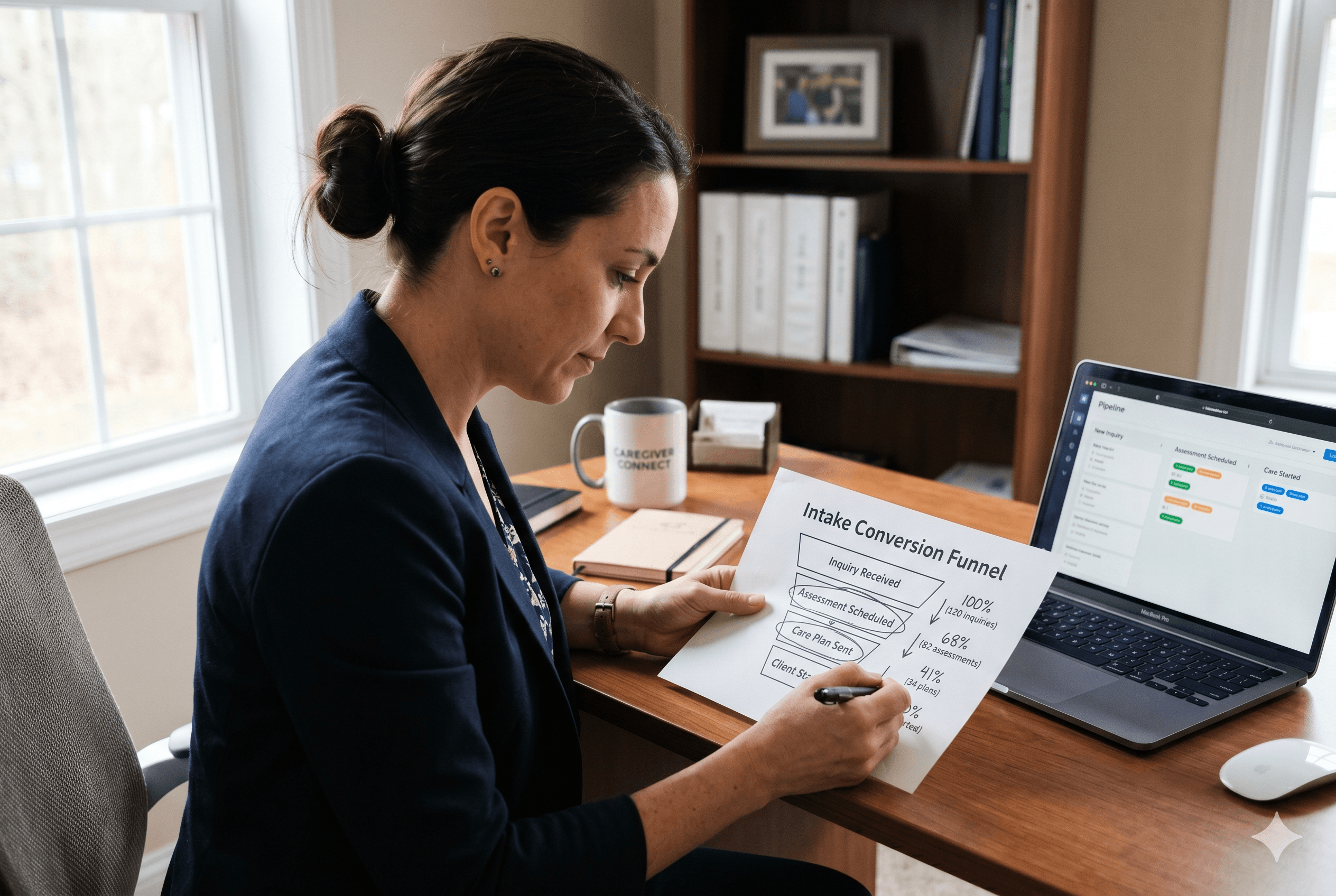
Families who find your agency through Google are often in an urgent situation. They are comparing multiple options simultaneously and making fast decisions. According to Sage Care's consumer research, 81% expect a response within one hour of first contact. An agency that wins the SEO battle and then takes two days to respond to the inquiry it generated has effectively wasted its ranking.
This is where converting search traffic into booked assessments depends as much on intake speed as on the quality of the website that drove the inquiry. The agencies that get the most from their SEO investment are the ones whose intake process is fast enough to convert the traffic it generates.
If you want to measure how well their intake process is actually performing against that traffic, tracking the specific metrics that connect search visibility to signed clients makes the return on SEO investment visible rather than assumed.
A Realistic SEO Timeline for Small Agencies
SEO is not a fast channel. Understanding what to expect and when helps agencies stay consistent rather than abandoning the investment before it produces results.
Timeframe | What to Expect |
|---|---|
Month 1 to 2 | GBP optimized, citations cleaned, first service area pages published |
Month 3 to 4 | Initial rankings for low-competition local terms, first organic inquiries |
Month 4 to 6 | Review volume building, blog content beginning to rank for FAQ queries |
Month 6 to 12 | Compounding traffic growth, AI search citations beginning to appear |
Month 12 and beyond | Sustained organic lead flow with minimal ongoing cost |
The agencies that reach month 12 with a functioning organic channel are the ones that treated SEO as a consistent monthly habit rather than a project with a finish line.
The Bottom Line
Home care SEO is one of the few marketing channels where a small independent agency can genuinely outperform a franchise. The keyword difficulty is low, the local search results favor agencies with genuine local presence over national brands, and the content families search for is specific enough that a well-written page from a real local operator will outrank a templated franchise location page almost every time.
The investment required is modest: a complete Google Business Profile, a consistent review cadence, a handful of service area pages, and one well-written blog post per month that answers a real question. Done consistently over six to twelve months, those activities build an organic lead channel that compounds without ongoing ad spend.
If you want to see how Sage Care helps agencies convert the search traffic they generate into booked assessments and signed clients, schedule a demo. The 30-day free trial is a practical way to see what faster intake does to the leads your SEO is already sending you.
Frequently Asked Questions
What is local SEO for home care?
Local SEO is the practice of optimizing your agency's online presence to appear in Google search results when families in your area search for home care services. It is driven primarily by your Google Business Profile, review volume, citation consistency, and locally relevant website content.
How do home care agencies rank on Google?
Rankings are driven by Google Business Profile completeness and activity, the volume and recency of Google reviews, consistency of your agency's name and address across directories, and the relevance of your website content to local search queries.
Should home care agencies write blog posts?
Yes, if the posts answer questions families are actually searching for. Generic content produces little SEO value. Specific posts covering local care costs, how to choose an agency, and what to expect during intake rank for high-intent queries and get cited by AI search engines.