How Fast Should a Home Care Agency Respond? Lessons from 500+ Consumer Surveys
81% of families expect a response within an hour. Most agencies take days. Here is what that gap costs.

Sage Care Editorial
Content & Communications Team

The answer is faster than most agencies think, and faster than most agencies do.
Sage Care surveyed more than 500 adults who had recently considered or purchased in-home care for themselves or a family member. The findings on response time were the most striking in the entire dataset, not because the expectations were surprising in isolation, but because of how far the average agency falls short of meeting them.
This post breaks down the key numbers, what they mean operationally, and what agencies can do to close the gap. If you want to read the full dataset behind these findings, the complete home care consumer survey results cover over 45 data points across discovery, trust, pricing, and decision-making behavior.
The Numbers That Define the Response Time Gap
These four statistics, taken together, describe the single biggest operational problem in home care client acquisition.
81% of families expect a response within one hour of their initial inquiry.
41% expect a response within 15 minutes.
44% of families said they waited days to hear back from an agency.
15% never received a response at all.
Read those numbers slowly. Nearly half of all families in the survey waited days for a response. One in seven never heard back. And yet four in five expect a reply within the hour.
That is not a small disconnect. It is a structural gap between what families need and what the industry delivers, and it plays out in every market, across agencies of every size, every single day.
What Each Statistic Means Operationally
What "81% expect a response within one hour" actually means for your agency
An hour is not a long time when someone is managing a full caseload, handling caregiver calls, and running assessments. But from the family's perspective, an hour is the outer boundary of acceptable, not a comfortable target.
The operational implication is that follow-up after an inquiry cannot be a task that waits for a quiet moment. It needs to be a system output, something that happens within a defined window regardless of what else is happening that day. Agencies that treat follow-up as something they get to when they can will consistently miss this window.
The families contacting your agency are often in an urgent situation. A parent has just been discharged from the hospital. A fall has happened. A family member can no longer manage care alone. In that context, an hour without a response does not feel like a minor delay. It feels like the agency does not have the capacity to help.
What "41% expect a response within 15 minutes" means for your intake process
This is the number most agency owners find difficult to accept, and understandably so. Responding to every inquiry within 15 minutes during a busy day is genuinely not feasible for a solo operator handling assessments, caregiver calls, and administrative work simultaneously.
But this statistic does not require your agency to respond to every inquiry in 15 minutes. It requires you to understand that nearly half of the families contacting you have already formed a negative impression of your agency if 15 minutes passes without any response.
The practical response to this is an automated acknowledgment: a message that goes out immediately when an inquiry is received confirming that someone will be in touch shortly. That single touchpoint, which can be automated and takes seconds to set up, resets the clock in the family's mind and signals that their inquiry was received and is being handled.
What "44% waited days to hear back" reveals about the industry
This statistic says something important: slow response is not a problem unique to poorly run agencies. It is the norm. The majority of home care agencies that are actively in business and presumably functioning reasonably well are still leaving families waiting for days before first contact.
That means the competitive opportunity for any agency that responds within the hour is enormous. You are not competing against a high bar. You are competing against an industry that has normalized a response time that its own customers find unacceptable. The agencies winning client acquisition in 2026 are not doing anything exotic. They are answering faster than almost everyone else in their market, which is a lower bar than it should be.
What "15% never heard back" means for your voicemail and inbox
One in seven inquiries to home care agencies receives no response. Ever.
This is the finding that is hardest to sit with because it is not about agencies that are slow or disorganized. It is about agencies that are losing leads they never even knew they had. A family that submits a contact form and never hears back does not call to complain. They contact the next agency on the list and move on. The original agency has no record of the lost lead, no signal that anything went wrong, and no opportunity to fix it.
This is exactly the problem that Sage Care's cold-call research confirmed from the supply side. When our team called 54 agencies as prospective clients, 22% of the voicemails we left went unreturned entirely. The consumer survey and the cold-call data are describing the same gap from opposite directions.
The Conversion Cost of Slow Response
Response time is not just a service quality issue. It is a direct driver of revenue.
Sage Care's consumer research found that 75% of families contact more than one agency before deciding. That means every inquiry your agency receives is a competitive situation where you are being evaluated alongside at least one other provider, often two or three. In that context, the agency that responds first has a structural advantage that is very difficult for slower competitors to overcome.
The math is straightforward. If your agency receives 20 inquiries per month and your current response time means you are losing even 30% of those leads to faster competitors, that is six potential clients per month who never become part of your caseload. At an average monthly revenue of $3,000 to $5,000 per private-pay client, slow response time has a measurable and significant cost.
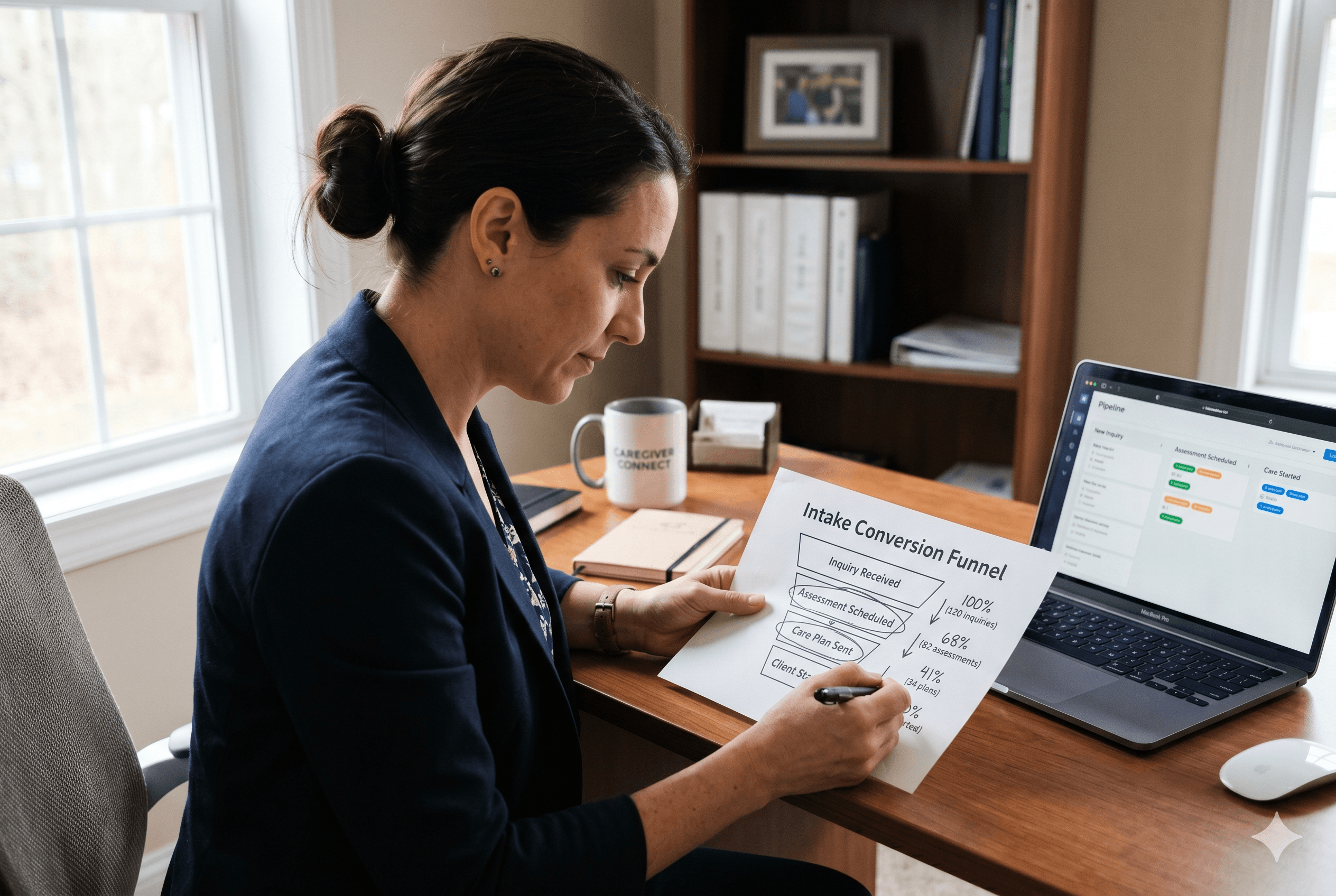
Tracking your current response time against your lead-to-assessment conversion rate is the clearest way to quantify what the gap is costing you specifically. Agencies that measure their intake KPIs from first inquiry through to care start almost always find that response time is the single variable most correlated with conversion rate improvement.
Why Response Time Is an Operations Problem, Not a Staffing Problem
The instinctive solution to slow response times is to hire someone whose job is to answer inquiries quickly. For most small agencies, that is not a viable option, and it is also not necessary.
Slow response time in home care is almost never caused by a lack of people. It is caused by the administrative work that follows every interaction competing directly with the follow-up that should happen immediately after it.
When documenting a call takes 20 minutes, and an assessment is scheduled for the afternoon, and two caregivers have called about schedule changes, the follow-up email to the morning's inquiry gets deferred. Not because anyone decided it was unimportant, but because the queue of things requiring attention is longer than the available time.
The solution is removing the documentation burden, not adding a person to carry it. When an AI generates the call summary, the care plan draft, and the follow-up email automatically after every interaction, the queue shrinks. The follow-up goes out the same hour. The lead does not go cold while paperwork is being completed.
This is the operational case for home care intake automation. Not as a technology preference, but as a practical response to a real constraint that is costing agencies clients every week.
What a Realistic Response Time System Looks Like
For a small agency looking to close the response time gap without hiring, a practical system has three components:
An immediate automated acknowledgment.
When an inquiry comes in through your website or contact form, an automatic reply goes out within seconds confirming receipt and setting an expectation for when someone will call. This costs nothing and immediately addresses the experience of the 41% who expect contact within 15 minutes.
A defined response window with a reminder system.
Every new inquiry should trigger a visible notification that prompts action within a specific time window, ideally 30 to 60 minutes. That prompt needs to be hard to ignore, not buried in an email inbox.
A documentation process that does not compete with follow-up.
If responding to an inquiry requires first finishing the notes from the previous call, the two tasks are in competition. Automating the documentation layer removes that competition entirely.
Together these three things produce a response time that consistently outperforms the industry norm without requiring additional headcount.
The Bottom Line
The response time gap in home care is not a mystery. Families expect fast, professional follow-up. The majority of agencies are not delivering it, not because they do not care, but because their intake process is built around manual work that cannot keep pace with inquiry volume.
Closing that gap does not require a new hire or a major operational overhaul. It requires a system that handles the documentation layer automatically so that follow-up can happen in the same window families expect it.
If you want to see how Sage Care helps agencies respond faster and convert more of the leads they are already receiving, schedule a demo. The 30-day free trial is a no-commitment way to find out what your current response time is actually costing you.
Frequently Asked Questions
How quickly should home care agencies respond to inquiries?
Consumer research shows 81% of families expect a response within one hour and 41% within 15 minutes. Agencies that consistently respond within 30 to 60 minutes during business hours are already outperforming the majority of their local competition.
What happens if you don't respond to a home care lead fast enough?
Families contact multiple agencies simultaneously. A slow response means the family has likely already scheduled an assessment with a faster competitor before your call back arrives.
What is the average response time in home care?
Based on Sage Care's consumer survey data and cold-call research, the majority of home care agencies take several hours to days to respond to new inquiries, and approximately 15 to 22% never respond at all.