Hidden Home Care Marketing Channels To Attract More Private Pay Clients
Unlock overlooked, modern marketing channels that help your home care agency stand out and grow.

Lowrie Hilladakis
Head of Growth, Sage

If you run a home care business today, you already know the basics of home care marketing. You have a website, maybe you run some Google Ads, and you nurture relationships with hospitals and rehabs. Yet growth still feels lumpy and unpredictable.
Often, that is not because you need to spend more. This is due to the underutilization of low-noise marketing channels. The agencies growing steadily in this market are quietly cultivating a mix of niche partnerships, a community presence, and modern home care software that keeps them responsive when interest spikes, especially as consumer expectations are reshaping home care services.
In this post, we will walk through the less obvious marketing channels that can reliably feed your funnel, and how AI technology in home care can help you actually capture and convert that demand.
1. Employer and HR partnerships
Most agencies think of “healthcare referrals” and stop there. However, work disruption triggers a surprising percentage of inquiries. An employee is suddenly juggling mom’s new diagnosis and a full-time job.
Instead of waiting for that person to Google you at 10 pm, build relationships with:
Local mid-sized employers
HR and benefits brokers
Employee Assistance Programs (EAPs)
Offer simple resources they can hand to employees: one-page guides on planning care at home, a short webinar on supporting aging parents while working full time, or a dedicated intake line for their staff.
This is where strong responsiveness matters. If an HR partner believes that providing your number will connect their employees to a live, professional intake experience at any hour, supported by reliable home care software and a structured agency management system for home care, they are much more likely to recommend your home care agency.
2. Faith communities
Churches, synagogues, mosques and other faith communities often know who is struggling long before a medical provider does. Instead of a generic brochure drop, approach faith leaders with specific, service-oriented ideas:
Host a “Caring for Aging Parents” Q&A session
Offer a free “home safety check” checklist for congregants
Provide a direct contact line for urgent weekend or evening support
Position your home care business as a resource, not a salesperson. Make it easy for volunteers to connect members to you by giving them a handout with a direct line, these types of warm introductions convert at a very high rate.
3. Local digital communities you are ignoring
Everyone talks about “being on social media,” but the most valuable conversations about home care rarely happen on your Facebook business page. They are happening in small, hyperlocal online spaces:
Neighborhood groups and marketplaces
Private Facebook groups for caregivers
Local senior center newsletters and community boards
City-specific subreddits or forums
Instead of posting generic ads, listen first. Look for patterns in the questions people ask about homecare costs, eligibility, schedules, and what to expect from caregivers. Then create content that answers those questions clearly and non-defensively.
This kind of educational presence also supports long-term growth by feeding referrals more consistently, to see how agencies systematize this, read this guide on growing a referral pipeline for home care agencies.
For example, you might:
Write a short guide on “What a 4-hour home care shift actually looks like for your parent” and share it when relevant.
Offer to do a live Q&A in a support group for family caregivers.
Provide a simple calculator or worksheet that helps families estimate hours and budget.
4. Non-clinical community professionals
Not every powerful referral source is a doctor or social worker. Many trusted professionals hear about family and care issues long before they reach a hospital:
Elder law and estate planning attorneys
Financial advisors and wealth managers
Real estate agents who specialize in downsizing or senior moves
Funeral homes and grief counselors
These partners are protective of their clients, so you need to lead with education and reliability.
You can offer co-branded resources like:
A “Planning For In-Home Care” guide that they can give clients
Joint webinars on coordinating legal, financial and care decisions
A simple referral process with clear expectations and feedback on what happened
When these professionals know that your home care business responds quickly and communicates clearly, they are much more likely to mention you during sensitive conversations. Again, modern home care software that keeps notes, tracks referrals and ensures timely follow up turns this from a one off effort into a repeatable channel.
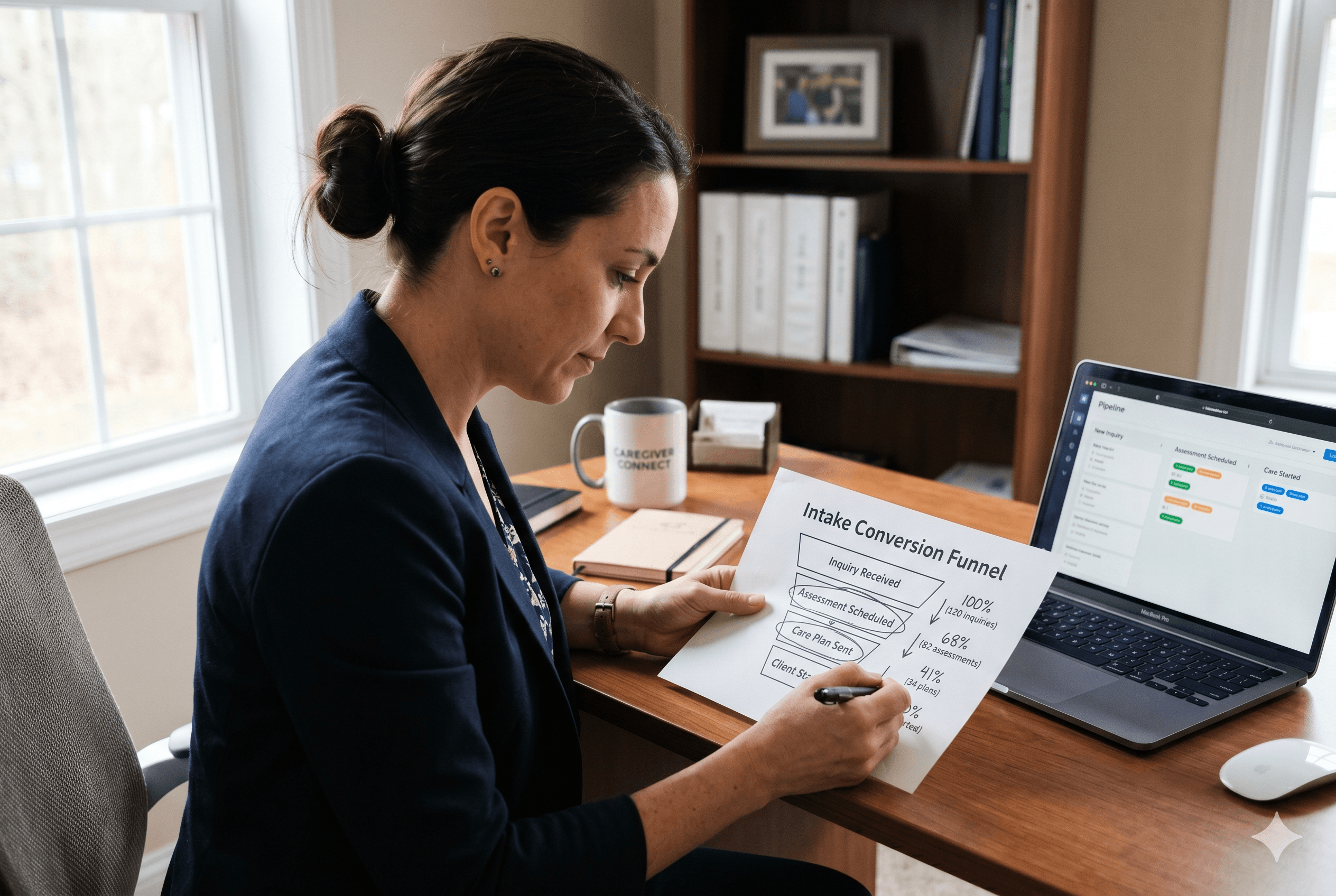
Without clear tracking, it is difficult to know which partnerships are actually performing, this is where monitoring key KPIs in home care operations, like referral conversion and response time becomes critical.
5. Turning existing operations into marketing
Some of the best marketing is an integral part of operations. It is the way your agency operates every day. As more agencies vie for the same families, market saturation in non-medical home care is turning operational excellence and responsiveness into a crucial differentiator, rather than a mere bonus.
A few operational changes can double as powerful marketing assets:
Radical responsiveness: If you can truthfully say, “We respond to new inquiries within minutes, 24/7,” that becomes a headline in your home care marketing. AI technology in home care makes this achievable without requiring you to sit by the phone all night when implemented thoughtfully with attention to AI in home care operations and compliance considerations.
Transparent communication: Sending families fast, clear summaries of each assessment, care plan update or schedule change can reinforce trust. When they feel cared for, they write better reviews and tell more friends.
Data you can share: If your home care software tracks metrics like average response time, visit completion rates, or family satisfaction, you can incorporate those numbers into your sales conversations and website. Data is a quiet but powerful differentiator.
Tools like Sage bring these pieces together. By combining a 24/7 virtual receptionist, often built on a modern VoIP provider for home care agencies, with an integrated AI assistant that drafts personalized follow-up emails, generates care plans and syncs back to your agency management system, you reduce intake admin time and free your team to deepen the very relationships that fuel these hidden marketing channels.
Bringing it all together
For teams that want to explore how AI supports intake and communication in a hands-on way before changing workflows, you can try our HomeCareGPT and see how conversational AI works in practice.
You do not need ten more ad platforms to grow your home care business. It would be beneficial to select a few well-chosen, underused channels that align with your market, along with having the operational support to respond promptly when people reach out.
Start by choosing two or three of the channels above that feel most natural in your community. Build simple offers and resources for each. Then make sure that every call, whether it comes at 10 am from an elder law attorney or 10 pm from a stressed adult child, is answered by a professional, consistent intake experience.
Your agency can transform hidden channels into steady, compounding growth through a combination of thoughtful strategy and reliable responsiveness.
To see how an AI-powered virtual receptionist and workflow assistant can help you capture and convert more of these opportunities, schedule a demo today to learn more about how Sage can help you grow your business.