Are We Reaching Market Saturation in Non-Medical Home Care in California?
Crowded, not capped: California home care grows fast but demand still outpaces supply.

Lowrie Hilladakis
Head of Growth, Sage

I’ve spent the past year building relationships across California’s senior care ecosystem — agency owners, care managers, placement advisors, and community programs. At local senior networking events, I consistently see that more than 30% of attendees represent non-medical home care. That’s a telling signal: the sector’s footprint is expanding fast, and operators are investing heavily in presence and partnerships to build their client census through qualified referrals.
The registration data backs it up: According to the California Department of Social Services' transparent reporting tool, more than 700 new home care agencies have registered in just under 12 months, roughly 200 of which are still pending licensure. In 2019, only 230 agencies registered in the same period; even last year, just under 400 registered. That’s a near-doubling year-over-year, and a tripling versus pre-pandemic baselines. Growth is real, visible, and accelerating.
Growth vs. Saturation: What’s Actually Happening
Saturation isn’t just about how many agencies exist — it’s about whether demand is fully met, whether differentiation is meaningful, and whether margins compress across the board. California’s non-medical home care landscape today reflects intense competition in top metros, but uneven coverage statewide, variable quality, and rising demand that continues to outpace supply in pockets.
Urban competition is fierce. In the Bay Area, LA, Orange County, and San Diego, operators are competing on speed-to-intake, payer mix, care plan sophistication, and reputation. Margins are tightening where operating costs rise and caregiver wages climb.
Suburban and rural gaps persist. Large swaths of the Central Valley, Inland Empire, and the North Coast remain under-serviced, with longer waitlists and fragmented availability for specialized care needs.
“Saturation” varies by acuity and service model. Dementia care, multilingual teams, complex ADL support, live-in arrangements, and hospital-to-home transitions are each distinct markets with different competitive dynamics. Agencies that specialize still find resilient demand.
In short: yes, it’s crowded — but California’s aging trajectory means we’re far from demand being “fully met.” The market is fragmenting, not flattening.
The Demand Story: Why Need Keeps Climbing
The aging population isn’t a headline — it’s a structural reality. As boomers cross into higher-need decades, we’re seeing longer lifespans paired with chronic conditions and a strong preference to age in place. Families increasingly choose home care over institutional options due to cost, quality of life, and flexibility. Health systems push for shorter stays with safer discharges. Payers and programs explore hybrid models that layer non-medical support to prevent readmissions.
Practically, this means the home care business has shifting demand “hotspots”:
Post-acute transitions that require reliable, fast-start services.
Cognitive decline cases where continuity and family engagement matter as much as tasks.
Chronic condition support where adherence and appointment coordination reduce downstream costs.
Language and cultural alignment in diverse communities that traditional agencies can’t easily serve.
These are not marginal niches—each is a durable growth lane. Agencies that build capabilities here can thrive even in dense markets.
If It’s Crowded, How Do You Win?
In a crowded market, the operators who break out do four things exceptionally well:
1. Nail intake speed and clarity
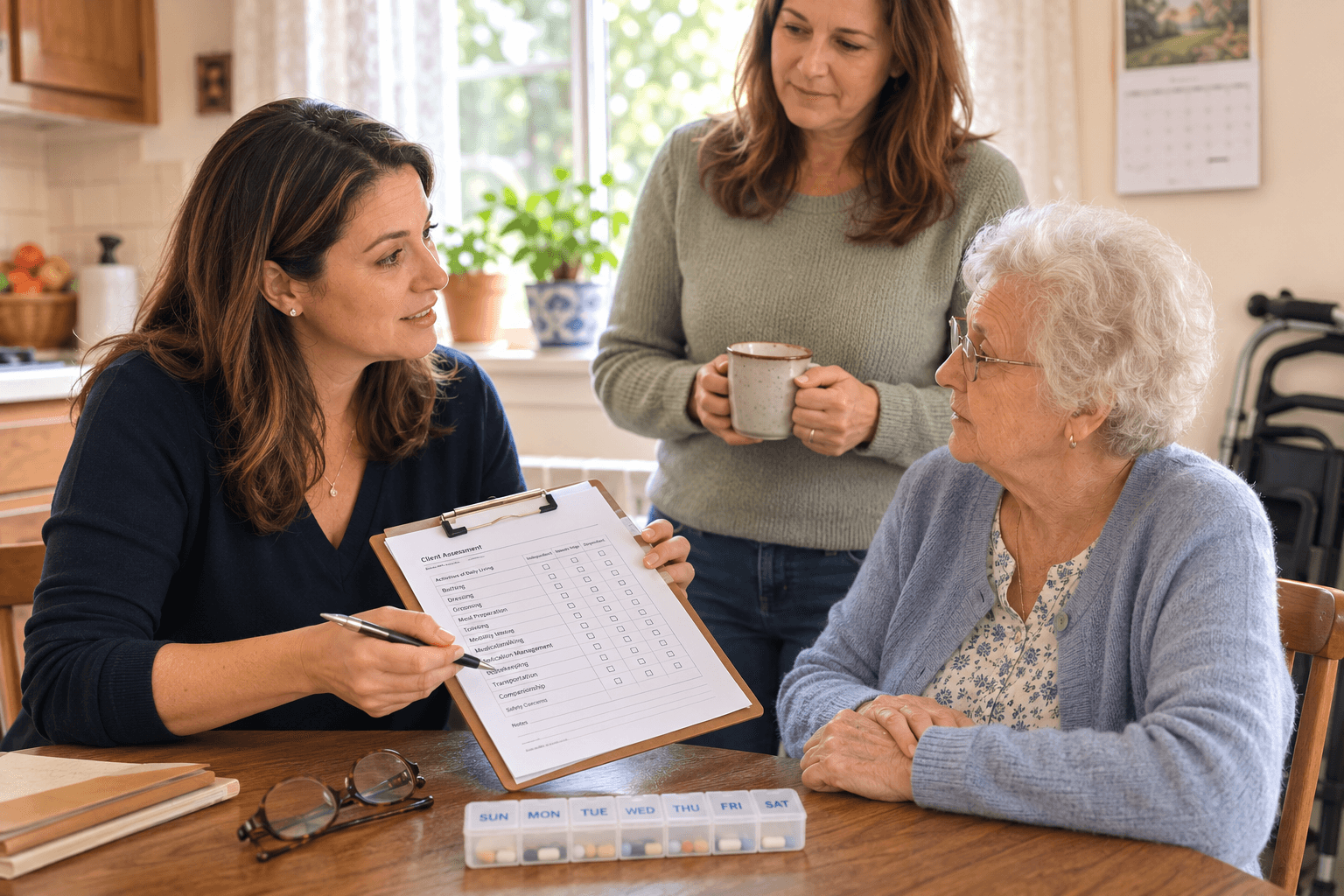
New inquiries convert when agencies respond instantly, articulate care plans in plain language, and remove friction from assessments. Emerging HIPAA compliant AI technology, like Sage, can automate documentation, organize assessments, and trigger follow-up sequences so care coordinators spend time on relationships, not repetitive clerical work.
2. Differentiate with outcomes, not adjectives
“Compassionate” is table stakes. What families and referral partners remember are real outcomes: fewer missed meds, reliable shift coverage, proactive check-ins, a care plan that adapts without chaos. This requires tight back-office workflows and data — to prove reliability and keep promises.
3. Build an efficient growth engine
Home care marketing isn’t just flyers and lunches. It’s CRM hygiene, referral partner segmentation, and consistent touchpoints that are actually tracked and acted on. A home care software stack that integrates tasks, notes, and communications keeps pipelines visible and prevents dropped balls.
For more insights on how you can capitalize on the path less walked for home care marketing, check out my blog on search engine optimization and digital marketing strategies for home care businesses.
4. Operate with discipline
As labor costs rise, the only way to protect margins is to reduce administrative overhead. Standardized documentation, templated care plan updates, and automated follow-ups are no longer optional. Agencies using home care ai technology for these fundamentals reclaim hours per coordinator per week—hours that convert into billable care.
Practical Strategy: Compete Where Saturation Hurts Less
Consider focusing your home care business on segments where availability, service consistency, and specialized training outperform generalist agencies:
Memory care programs with caregiver training, family coaching, and structured routines.
Hospital-to-home bundles tightly aligned to local discharge planners with guaranteed same-week starts.
Multilingual teams tied to specific community organizations and faith networks.
Live-in or extended-hour blocks that reduce scheduling complexity and deliver continuity families can feel.
Pair that with operational excellence: capture every inquiry, triage with urgency, log every referral touchpoint, and keep your documentation airtight. This is where home care software with AI technology can give you leverage — less paperwork, more caregiving, and cleaner visibility into operations.
Crowded, Competitive — And Full of Opportunity
From what I’m seeing on the ground — networking attendance, rapid licensure growth, and metro-level competition — California is entering a new phase of home care business. The agencies that will endure are those that align their brand promise with operational proof, and those that unify their intake, care coordination, and follow-up communications into a single, reliable system.
This is precisely why we built Sage by Clara: an AI-native, HIPAA-compliant platform purpose-built for home care. We automate documentation, organize communications, and integrate with your existing management system so your team can focus on care and connection rather than paperwork. In a crowded market, consistency, speed and human connection are your differentiators — Sage exists to make both repeatable.
To see how Sage can help you reduce admin burden, tighten intake, and strengthen referral follow-up, schedule a demo today to learn more about how Sage can help you grow your business: schedule a demo ↗.