Stop Losing Leads to Paperwork: How Intake Automation Changes the Game for Home Care 
Intake automation helps home care agencies stop losing valuable leads to paperwork.

Sage Care Editorial
Content & Communications Team
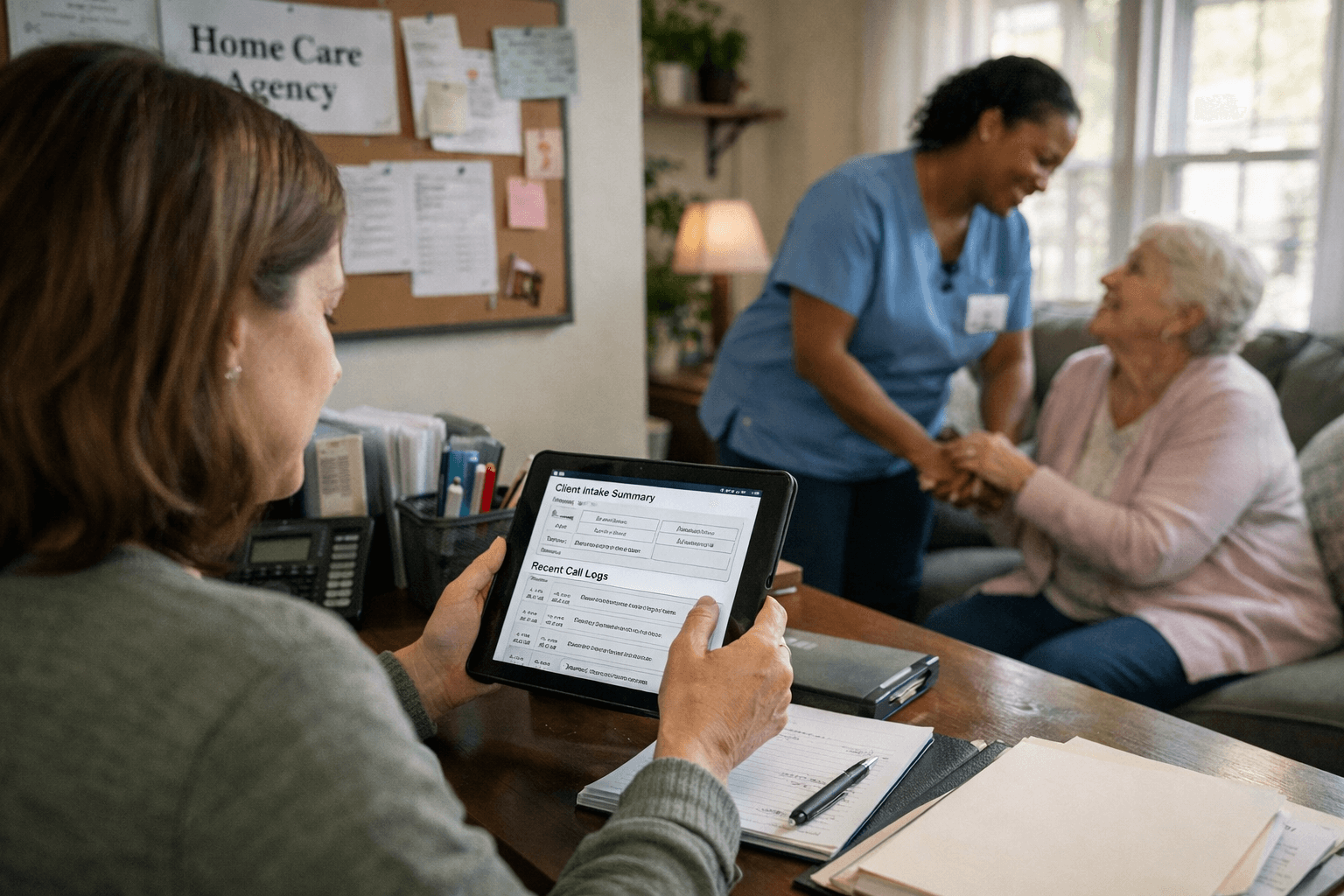
Every missed call, delayed follow-up, or lost sticky note is a lost client. For a small home care business, that is not an inconvenience; it is the difference between growing and treading water. Intake automation turns the messy, manual process of tracking inquiries, calls, and assessments into a consistent, repeatable system that captures more of the leads you are already getting.
This post breaks down what intake automation is, why paperwork is quietly killing your conversion rate, and how platforms like Sage help home care agencies convert more leads without hiring more staff.
If you are trying to improve admissions without increasing your marketing spend, the numbers behind that shift are explained in these home care intake KPIs for calls, conversions, and growth.
The real cost of paperwork in home care intake
Most young agencies run intake with a patchwork of tools: a cell phone, paper forms, spreadsheets, and maybe a basic home care CRM. That setup feels scrappy and flexible, but it hides serious leaks.
In practice, intake breaks down in a few predictable ways:
Calls end with “I will email you details later," but the follow-up takes hours or never happens
In-home assessments generate pages of notes that sit in folders instead of driving timely care plans
Staff spend 15 to 30 minutes after each interaction typing notes, updating records, and writing emails
There is no single view of where each lead is in the intake pipeline, so hot leads go cold
It is the same bottleneck many agencies face before they transition to a structured home care CRM workflow instead of relying on spreadsheets.
Industry surveys often show that agencies taking more than 24 hours to follow up on an inquiry lose a large share of those prospects to competitors. When you only get a handful of new leads each week, losing even one or two because of slow admin work has a real revenue impact.
Paperwork does not just waste time. It directly lowers your conversion rate.
What is home care intake automation?
Home care intake automation uses software to capture and organize everything that happens from first inquiry through care plan creation, then removes as much manual data entry and follow-up writing as possible.
Instead of starting from a blank screen after every call or visit, the system:
Records and transcribes the interaction
Generates a clear summary in plain language
Draft follow-up emails or texts
Suggests updates to client records and care plans
Tracks where the lead sits in your intake pipeline
With Sage, this all happens right after a call or in-home assessment. The AI creates summaries, draft follow-up messages, and records suggestions that your team can review and approve with one tap.
This is the same operational shift that happens when you optimize the journey from initial inquiry through care plan creation, where less admin time means faster follow-up and higher conversion.
Work that once required 15 to 30 minutes per interaction usually falls to under five. For a one-to-two-person intake team, that is the difference between reacting to demand and being ready for it. Intake automation also improves lead management for home care in three concrete ways: speed, consistency, and visibility.
Faster follow-up, less lead decay
Response time is one of the strongest predictors of whether a family will choose your agency. Because Sage auto-generates follow-ups from actual call recordings and transcripts, staff only need to skim, tweak, and send. That makes it realistic to respond quickly, even on busy days. This phenomenon is exactly why agencies using AI call summaries to speed up follow-up consistently outperform manual workflows.
Consistent documentation, fewer errors
Relying on handwritten notes and memory guarantees gaps. With intake automation, every interaction is captured, transcribed, and summarized the same way. Sage keeps a unified activity history of calls, recordings, transcripts, and AI-generated summaries tied to each patient and contact. That consistency reduces miscommunication and presents a cohesive, professional experience to families and referral partners.
Pipeline visibility for owners
As an owner operator, you need to know exactly what is happening with each lead without digging through texts, voicemails, and spreadsheets.
Sage replaces standalone home care CRM (Customer Relationship Management) tools by centralizing contacts, relationships, and intake stages in one place. You can quickly see which leads need a nudge, which are stalled, and where most drop-offs happen.
That visibility turns intake into a measurable growth engine and directly informs better marketing decisions for home care.
Where AI technology in home care actually fits
AI technology in home care is often framed as a replacement for people. Intake does not work that way.
The real opportunity is using AI to handle the repetitive, back-office work that happens after human conversations.
In Sage, AI:
Listens in on calls and in-home assessments via built-in VOIP and recording
Turns unstructured conversations into structured summaries
Suggests updates to care plans and records
Draft communication so staff can focus on relationships
This behind-the-scenes model is also what allows agencies to stay compliant while moving faster, as explained in this overview of using AI in home care while protecting PHI and meeting HIPAA requirements.
How Sage fits into your existing home care software
Many upstart agencies already use an agency management system like WellSky for scheduling and billing. Sage does not replace those systems. It plugs into them.
Sage provides:
A HIPAA-compliant intake workspace focused on lead capture and early client onboarding
Bidirectional sync with WellSky for patient data and care plans
Built-in VOIP on iOS with call recording and voicemail
An integrated home care CRM and contact directory
If you are evaluating how these tools work together, this practical guide to what an agency management system is and how it connects to your intake workflow explains the structure.
The result is a streamlined software system for home care where your AMS handles operations and Sage manages intake automation and communications.
What intake automation means for a 1–2 person team
If you are running a home care business with a tiny team, this changes daily work in very practical ways:
Less context switching because everything lives in one place
More time talking to families and less time typing
Professional, consistent follow-up
Capacity to grow without immediate hiring
Sage’s 30-day free trial gives agencies enough time to see this impact across a full intake cycle.
Turning your intake process into a growth engine
Paperwork should never be the reason a good lead slips away. By using automated intake for home care, you give your agency a reliable system for capturing every inquiry, documenting every conversation, and following up quickly with families who are ready to move forward.
Sage brings client intake automation, home care CRM (Customer Relationship Management), VOIP (Voice Over Internet Protocol), and AMS (streamlined software system for home care where your AMS handles operations and Sage manages) integrations together in a single AI-powered workspace built for home care.
If you want to convert more of the leads you already have and reduce the admin burden on your tiny team, schedule a demo and start your 30-day free trial to see the impact on your intake process.
FAQs about home care intake automation
How does home care intake automation help small agencies?
It reduces manual admin work after calls and visits so small teams can follow up faster and more consistently.
Is Sage an AI receptionist?
No. Sage does not answer calls. It automates documentation and follow-up after your team’s conversations.
Does Sage replace my existing home care software?
No. It complements your AMS (Agency Management System) and serves as an intake-focused home care CRM (Customer Relationship Management) system.
Is Sage safe for patient information?
Yes. Sage is a HIPAA-compliant platform, meaning it meets the standards of the Health Insurance Portability and Accountability Act, which ensures the protection of sensitive intake data.
Do I need to be tech-savvy to use Sage?
No. Workflows are based on the calls and assessments you already do, with simple review and approval steps.


