How AI Is Reshaping Home Care Intake and Documentation in 2026
AI is transforming how home care agencies handle intake, calls, and documentation. Here is what is changing in 2026.

Sage Care Editorial
Content & Communications Team
Running a home care agency in 2026 means competing on speed, professionalism, and follow-through. The agencies winning more clients are not necessarily the ones with the biggest referral networks. They are the ones who respond faster, document better, and convert inquiries into signed care agreements before the competition gets a second chance.
AI is making that possible, and it is doing it in a very specific part of the business: the intake and documentation workflow. If you want to understand where the technology is actually being applied, and where it still falls short, this post lays it out clearly.
For a deeper look at the full scope of what AI-powered tools are doing in this space, the AI intake software guide for home care agencies is a useful starting point.
Why 2026 Is a Turning Point for AI in Home Care
Home care has historically been slow to adopt technology. Paper intake forms, phone message logs, and shared spreadsheets are still common across smaller agencies. But that is changing quickly, for two reasons.
First, consumer expectations have shifted. Families researching home care for a loved one are comparing agencies the same way they compare any service provider: on responsiveness, professionalism, and clarity.
Research from Sage Care's survey of 500+ home care consumers found that response time and communication quality are among the top factors families use when choosing between agencies. A slow, manual follow-up process is no longer just an inconvenience. It is a competitive liability.
Second, the tools have finally caught up with the problem. Practical AI applications, things that handle transcription, summarization, drafting, and record-keeping, are now accessible to small agencies without large IT budgets or dedicated technology staff.
What AI Is Actually Doing in Home Care Right Now
It is worth being precise here, because there is a lot of noise around AI in healthcare generally. In home care specifically, the most useful and widely adopted AI applications fall into four areas.
Automated Call and Visit Transcription
Every intake call and in-home assessment contains valuable information: the client's care needs, family concerns, medical history, and expectations. Capturing that information accurately used to depend entirely on whoever was taking notes.
AI-powered transcription changes that. When a call or assessment is recorded, the audio is automatically converted into a searchable, structured transcript. Nothing gets missed because someone was writing while listening.
Post-Call and Post-Visit Documentation
Transcription is only the first step. The bigger time drain for agency staff is what happens after the call or visit: writing up summaries, drafting follow-up emails, updating the client record, and preparing care plan notes.
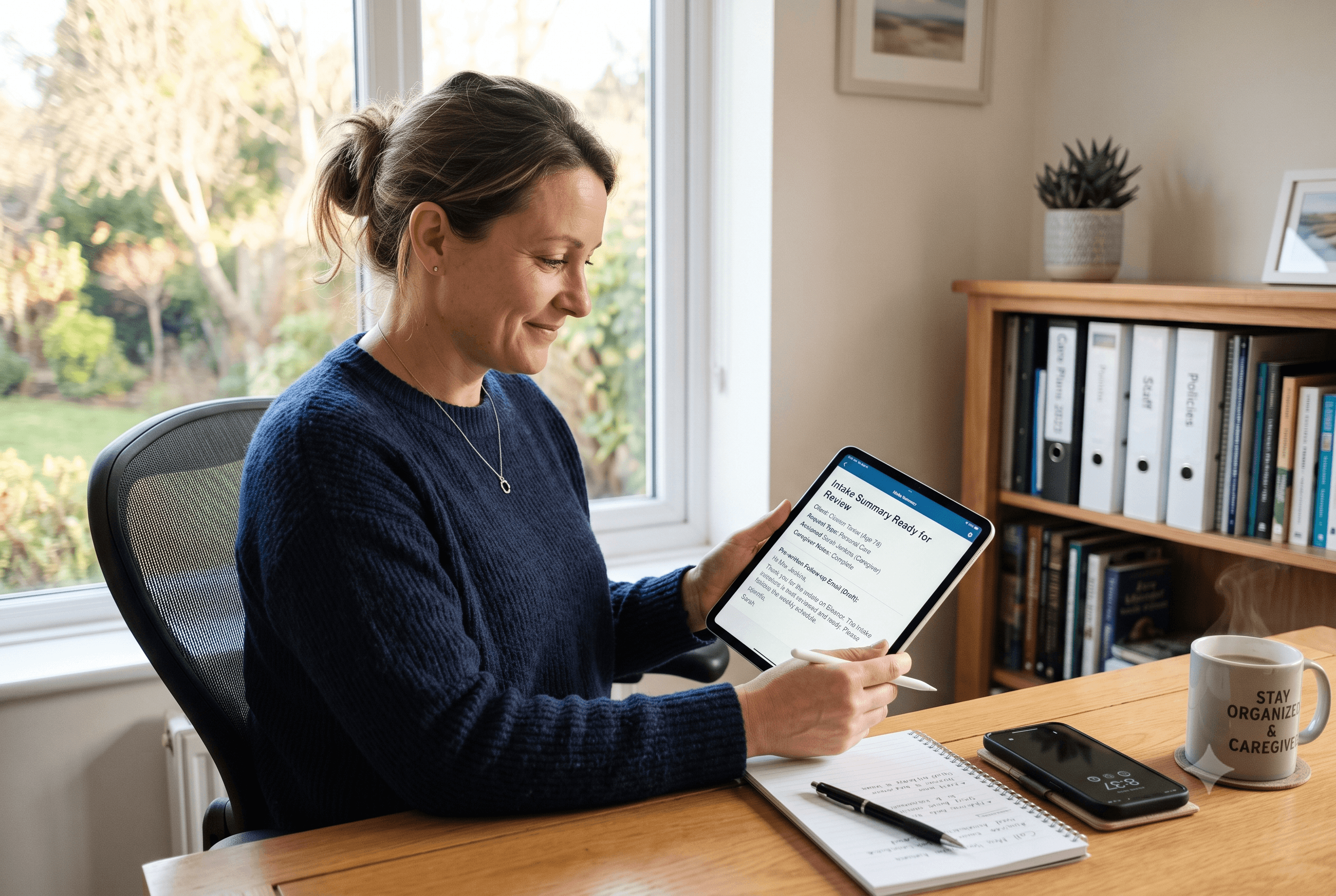
AI tools can now generate all of that automatically. After a call is recorded and transcribed, the system produces a draft summary, a suggested follow-up email, and proposed updates to the client record, all in under a minute. Staff review the drafts, make any edits, and approve. What used to take 15 to 30 minutes per intake contact now takes under five.
This is the core function of what the industry is beginning to call an AI scribe for home care, a tool that handles documentation automatically so clinicians and intake coordinators can focus on the conversation itself.
Care Plan Generation
After an in-home assessment, the care coordinator needs to translate what they observed into a formal care plan. Drafting that document from scratch is time-consuming and prone to inconsistency across staff members.
AI tools can generate a structured care plan draft from assessment notes or transcripts. The coordinator reviews and edits it, but the blank-page problem is eliminated. The result is faster turnaround and more consistent documentation across the agency.
Intelligent Client Communications
Following up with prospective clients promptly and professionally is one of the biggest challenges for small agencies. When one person is managing intake, scheduling, and operations at the same time, leads fall through the cracks.
AI-assisted communications tools draft personalized follow-up messages based on the content of the intake call. Instead of writing each email from scratch, the staff member reviews a ready-to-send draft and approves it with a single tap.
How the Workflow Has Changed: Before and After
The table below shows what the intake and documentation workflow looks like for a typical small agency, with and without AI tools.
Step | Without AI | With AI |
|---|---|---|
Intake call | Manual notes, easy to miss details | Auto-transcribed, full record captured |
Post-call summary | Written by hand, 10 to 15 minutes | AI draft generated in under 60 seconds |
Follow-up email | Written from scratch per client | Draft ready for review and one-tap send |
Client record update | Manual data entry | Suggested updates generated automatically |
Care plan draft | Written from blank page | Generated from assessment transcript |
Total admin time per intake | 15 to 30 minutes | Under 5 minutes |
The shift is not about replacing the people doing this work. It is about removing the low-value manual steps so that the same person can handle more volume, respond faster, and give more attention to the conversations that actually convert leads into clients.
What AI in Home Care Does Not Do Yet
Setting accurate expectations matters here. The current generation of AI tools in home care is strong on documentation and communication. It is not replacing clinical judgment, scheduling decisions, or caregiver management.
Specifically, AI tools in this space do not:
Make clinical decisions or provide medical recommendations
Handle caregiver scheduling or shift management
Manage compliance, billing, or payroll
Replace the intake coordinator's judgment about client fit or care needs
The value is in reducing administrative overhead, not in automating the human relationships that define good home care.
What Home Care Agencies Are Getting Wrong About AI Adoption
Many agencies hesitate to adopt AI tools because they expect a complex implementation process or worry about disrupting their existing workflows. In practice, the agencies seeing the most benefit are using AI to complement their current setup, not overhaul it.
The second common mistake is expecting AI to work without human review. The best implementations treat AI output as a first draft: accurate, fast, and useful, but still reviewed by a staff member before anything goes to a client. This keeps quality control in place while dramatically reducing the time cost of documentation.
For agencies still managing intake in spreadsheets, the operational case for a more structured system is worth examining. This post on moving from spreadsheets to CRM for home care operations walks through what that transition looks like in practice.
How Sage Care Is Built Around This Shift
Sage Care is a HIPAA-compliant intake automation platform built specifically for home care agencies. It connects every part of the post-call and post-visit workflow into a single tool.
After every call or in-home assessment, Sage Care automatically generates summaries, draft follow-up emails, care plan updates, and record suggestions. Staff review, edit if needed, and approve with one tap. The platform includes built-in VOIP on iOS so all calls and assessments are recorded and logged directly to the client record.
Sage Care also integrates bidirectionally with WellSky and AxisCare, so client data and care plans stay in sync with your existing agency management system without duplicate data entry.
For agencies comparing options across the broader software landscape, this non-medical home care software comparison guide breaks down what to look for when evaluating tools at different stages of agency growth.
The Bottom Line
AI is not going to run your home care agency for you. But it is already doing the administrative work that slows agencies down: the post-call writeups, the follow-up emails, the care plan drafts, and the record updates that pile up every time your phone rings.
The agencies adopting these tools in 2026 are not doing so because they love technology. They are doing it because they want to respond faster, document more consistently, and convert more of the leads they are already getting.
If you want to see what this looks like for your agency, schedule a demo with Sage Care and we will walk through the workflow with you. There is no obligation, and Sage Care offers a 30-day free trial so you can test it against your real intake volume before committing.
Frequently Asked Questions
What does AI actually do in home care intake?
AI in home care intake handles the documentation and communication tasks that happen after calls and visits: transcribing recordings, drafting summaries and follow-up emails, generating care plan notes, and updating client records automatically.
Is AI in home care HIPAA-compliant?
Platforms built for home care, like Sage Care, are designed to meet HIPAA requirements. Always verify that any AI tool you adopt has documented HIPAA compliance before using it for client data.
Do I need technical skills to use AI intake tools?
No. The best home care AI tools are designed for agency operators, not IT departments. The workflow is review-and-approve, so staff interact with outputs rather than configurations.


