Do You Need a Home Care Marketing Agency? ROI, Red Flags, and Better Alternatives
How to decide, what to avoid, and smarter options for home care growth

Sage Care Editorial
Content & Communications Team

Home care is a trust business. Families choose you because you show up with compassion and competence. Marketing should reflect that. The challenge is knowing when to hire a home care marketing agency, what returns you should expect, and how to avoid costly missteps that drain time, budget, and focus from your core work. This guide breaks down the ROI math, the red flags to watch for, and practical alternatives that can help your home care business grow without the agency markup.
When a home care marketing agency makes sense
Agencies can be valuable in specific scenarios:
You need specialized capabilities you cannot staff in house for the next 6 to 12 months, such as technical SEO, paid search at scale, or high production video storytelling.
You have consistent lead volume but poor conversion, and you want audit level diagnostics of your intake journey, call handling, and follow up operations.
You are entering a new market, launching a new service line, or scaling from one office to multiple locations, and you need repeatable playbooks.
In those cases, the right agency can act as a force multiplier. For many agencies, however, the bottleneck is not awareness. It is converting inbound interest and referrals into intakes that stick. That is an operational problem — one where home care software and AI technology in home care can do more, faster, and at lower cost.
The ROI math you cannot skip
Whether you keep marketing in house or hire an agency, your decision should pass a simple ROI test. Use these baseline assumptions to evaluate spend:
Lead value: Estimate average client lifetime value by multiplying average monthly revenue by expected months retained. For non medical home care, a common range is 2,000 to 6,000 dollars per month and 6 to 18 months.
Conversion rate: Track inquiry to start of care. Aim for 20 percent or higher with disciplined intake and follow up.
Acquisition cost target: As a rule of thumb, customer acquisition cost should be 10 percent to 20 percent of lifetime value for sustainable growth.
Put it together. If your average lifetime value is 36,000 dollars and your target acquisition cost is 15 percent, you can spend up to 5,400 dollars per new client profitably. If an agency retainer is 6,000 dollars per month plus 3,000 dollars in ads and you net five new clients monthly, your acquisition cost is 1,800 dollars per client. That is attractive. If you net only one client, your acquisition cost jumps to 9,000 dollars — that is likely underwater.
The takeaway is simple. Require clear projections, weekly reporting, and conversion tracking. If the numbers are not trending to target by week four, adjust quickly.
Red flags when hiring a marketing agency
Vague attribution: If an agency cannot show how website updates, SEO content, and paid campaigns map to inquiry volume and booked consultations, walk away. Home care marketing without attribution is guesswork.
Leads without intake improvements: More calls are not helpful if your team is overwhelmed and under documented. A good partner focuses on intake flow, not just traffic.
One size fits all assets: Boilerplate blogs, generic landing pages, and stock heavy creative erode trust. Families notice. Your brand should feel local, specific, and credible.
No HIPAA awareness: Home care handles sensitive information. Messaging, call workflows, and software choices must respect privacy and compliance. If they dismiss this, that is a risk.
Long lock in contracts: If value is real, month to month or short terms are fine. Avoid 12 month commitments unless milestones are tied to real outcomes.
These red flags often point to a deeper issue. Agencies can amplify what already works, but they cannot fix intake friction on their own. That is why operational tooling matters.
Better alternatives: Optimize intake first
Most home care businesses do not need more marketing spend. They need more efficient intake. Each prospective client or family caregiver who calls, emails, or completes a contact form represents substantial potential value. Losing a single qualified inquiry because notes are incomplete, follow up is delayed, or care plans are slow to draft is costly.
This is where AI technology in home care is materially changing the equation. Purpose built tools like Sage accelerate conversion by removing administrative busywork from the first conversation to the signed service agreement. Sage is home care software designed for operators and integrates with the systems you already use. Here is how it helps:
Automating call recording, transcription, and summarization so your team never has to take notes on a call again. That means you capture details accurately, build trust by reflecting needs back clearly, and move faster to the next step.
Generating instant follow ups, with personalized drafts ready to send before you hang up. Timely, professional follow up is one of the strongest predictors of conversion in home care marketing.
Populating draft care plans from call data. Families see momentum and competence. Your coordinators spend time confirming and customizing instead of re typing.
Syncing directly with your existing agency management system. No copy paste, no duplicate entry, fewer errors, and faster starts of care.
When intake is streamlined, the same marketing budget produces more clients. You save up to 100 minutes per prospective client, reduce leakage, and shorten time to start. That is how you turn existing demand into reliable growth.
Practical steps to decide what to do next
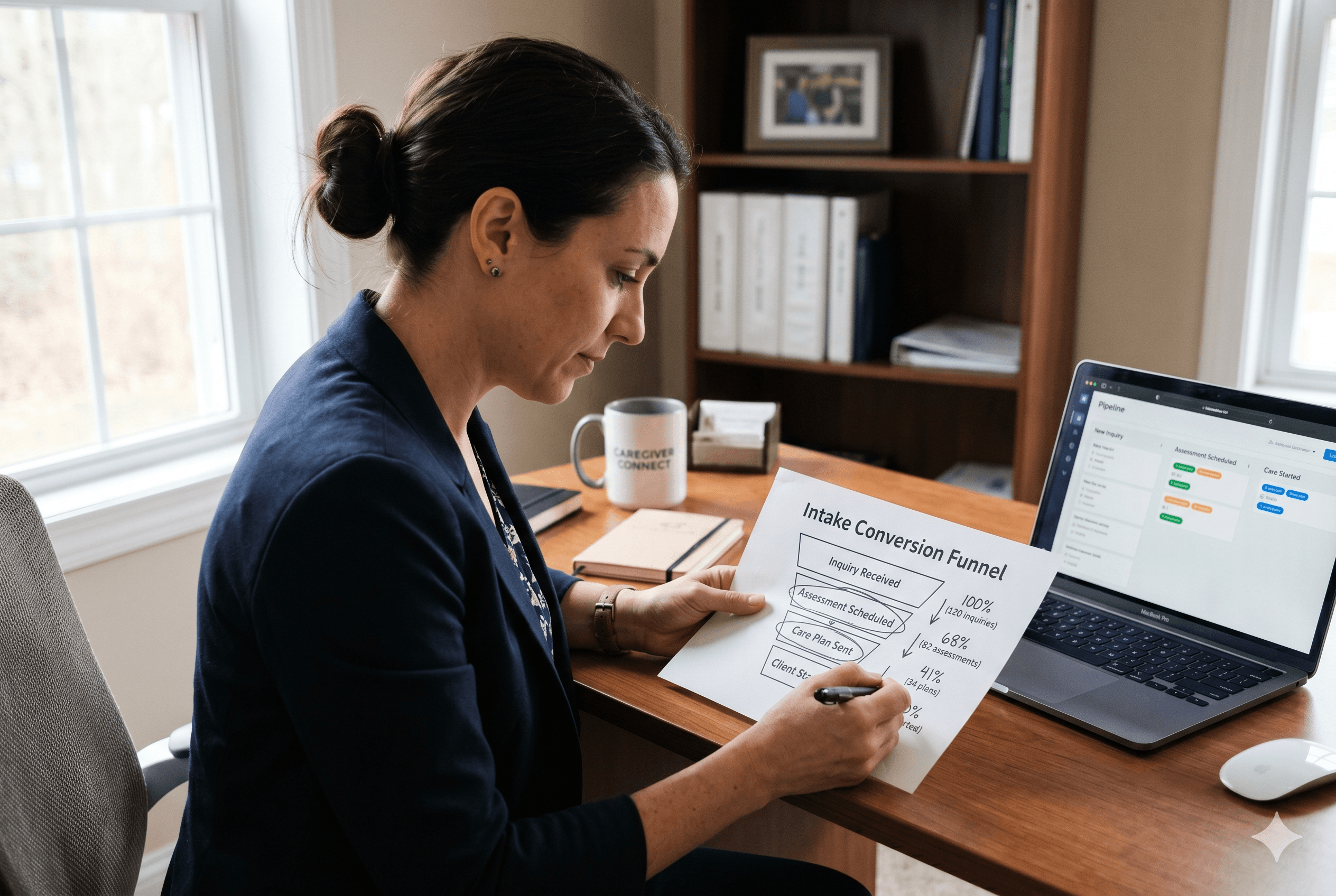
Audit your funnel: Count inquiries, booked consultations, assessments, starts. Identify the biggest drop offs. Often the largest gap is between inquiry and scheduled consultation.
Fix response time: Aim to respond within 5 minutes during business hours. Use templates for the top three scenarios — Alzheimer’s care, post surgical recovery, and respite requests.
Standardize follow ups: Send a summary of the conversation, next steps, and required documents within 30 minutes. Automate where possible.
Elevate your website basics: Clear services pages, local proof points, FAQs, and a prominent phone number. This is foundational home care marketing.
Layer paid thoughtfully: Start small with branded search to capture high intent traffic, then expand. Measure weekly.
Once these are in place, consider specialized agency help for specific campaigns or creative that extends your brand. With intake optimized, you will get far higher ROI from any outside spend.
The bottom line
You do not always need a home care marketing agency. You do need a reliable, high converting intake engine. For many home care businesses, improving intake operations delivers better returns than increasing advertising. If you decide to hire, use the ROI math above and watch for red flags. If you decide to optimize first, modern home care software like Sage gives your team the leverage to handle more inquiries, follow up faster, and start care sooner — all while protecting privacy and integrating with your system of record.
To see how Sage can streamline your intake and boost conversion, schedule a demo today to learn more about how Sage can help you grow your business.