
Why HubSpot Isn't Built for Home Care (And What Actually Works)
HubSpot is great software. It is not built for home care intake. Here is what the gaps actually cost you.

Sage Care Editorial
Content & Communications Team
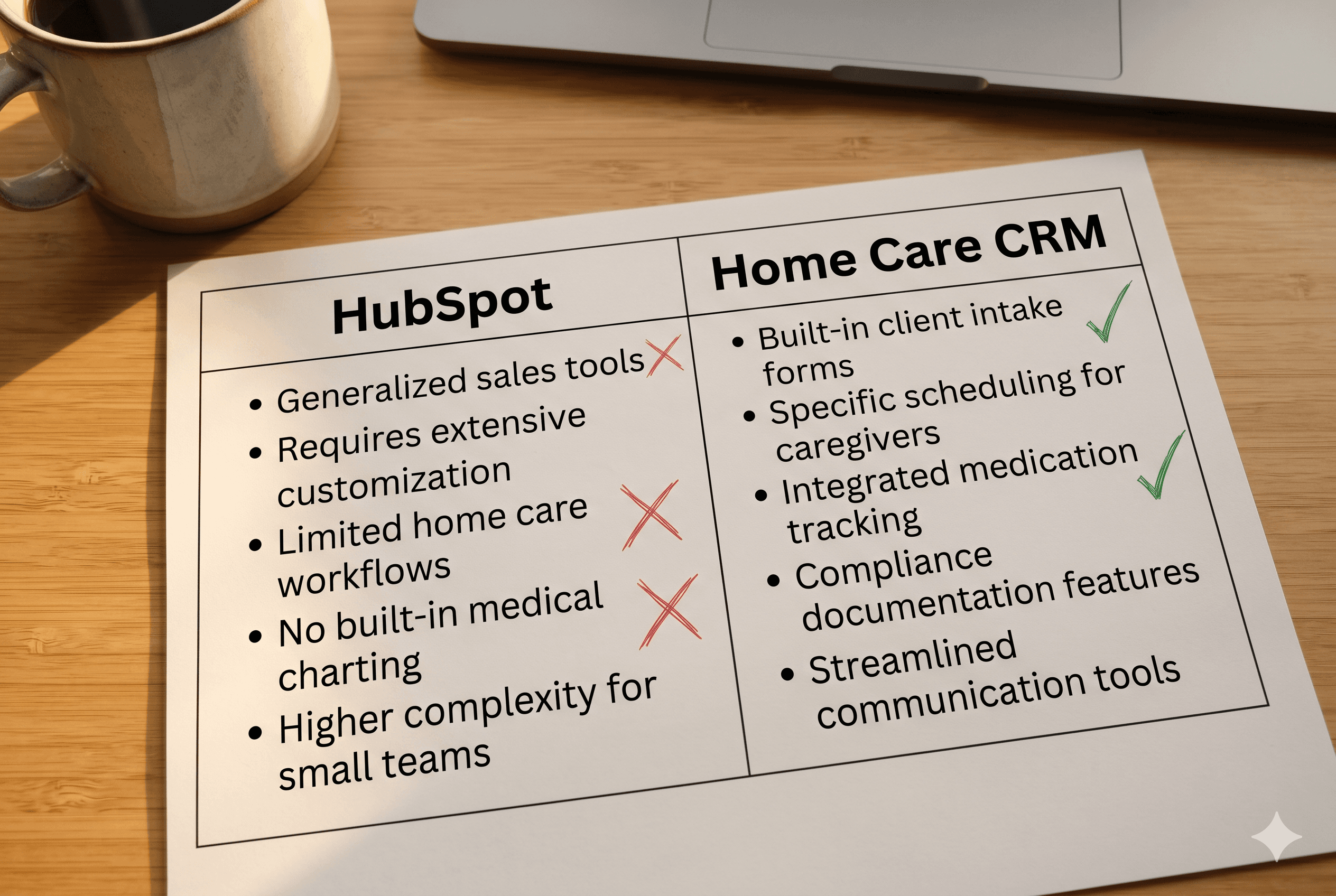
HubSpot is genuinely good software. It has a polished interface, a strong free tier, and enough features to run marketing and sales operations for almost any service business. It is also one of the most common tools home care agency owners try first when they decide to move off spreadsheets, and one of the most common tools they abandon six months later.
The problem is not that HubSpot is bad. The problem is that home care intake is a specific workflow with specific requirements, and HubSpot was not designed with any of them in mind. The move from spreadsheets into a structured system is the right instinct. The tool you land on matters as much as the decision to move.
This post walks through exactly where HubSpot falls short for home care agencies, what it does well, and what a home-care-native alternative actually looks like in practice.
What HubSpot Is Actually Built For
HubSpot was designed for B2B sales and marketing teams. Its core strengths are email marketing automation, website lead capture, sales pipeline tracking, and reporting dashboards for teams managing large volumes of leads across long sales cycles.
Those strengths translate reasonably well to industries where the product is digital, the buyer is a business, and the sales cycle involves multiple marketing touchpoints over weeks or months. They translate poorly to home care, where the buyer is a family in a stressful situation, the sales cycle is measured in days not months, the intake process involves in-person assessments and care plan documentation, and the operational backend runs on AMS software that HubSpot has no connection to.
Where HubSpot Falls Short for Home Care Agencies
No AMS Integration
This is the most significant gap and the one that creates the most ongoing friction. Home care agencies running on WellSky, AxisCare, or any other agency management system need their intake data to flow into their AMS when a client starts care. HubSpot has no native integration with any major home care AMS.
That means every time an inquiry converts to a client, someone has to manually re-enter client information, care needs, contact relationships, and care plan details into the AMS from scratch. For a busy agency, that manual transfer happens multiple times a week and introduces the exact kind of data entry errors and omissions that a CRM is supposed to eliminate.
The agencies that stick with HubSpot long-term typically end up with two parallel systems that never fully sync, a HubSpot pipeline that reflects the pre-client stage and an AMS that reflects post-client operations, with a manual handoff between them that depends entirely on someone remembering to do it correctly every time.
No In-Home Assessment Recording or Documentation
The in-home assessment is the most information-dense event in the home care intake process. In the space of an hour, a care coordinator captures the client's health status, ADLs, IADLs, home environment, family dynamics, caregiver preferences, and the details needed to build a care plan. That information needs to be documented, structured, and accessible immediately afterward.
HubSpot has no concept of an in-home assessment. It has no recording capability, no structured assessment template, and no workflow for converting a visit into a care plan. Agencies using HubSpot for intake typically document assessments in a separate Google Doc or paper form, then manually summarize the relevant information into HubSpot's notes field. The result is unstructured data that cannot be searched, reported on, or automatically transferred into the AMS.
No Care Plan Workflow
Care plan creation is a core output of the home care intake process. A completed assessment should produce a structured care plan that documents the client's needs, caregiver instructions, scheduling requirements, and review schedule. That document then needs to live somewhere accessible to both the agency and the caregiver.
HubSpot is a sales and marketing tool. It does not have a care plan template, a care plan approval workflow, or any mechanism for generating structured clinical or quasi-clinical documentation from an intake conversation. Building a workaround using HubSpot's custom fields and document attachments is possible but produces a fragile, non-standardized process that breaks whenever a team member is unavailable.
No Built-In Telephony for Home Care Workflows
Phone calls are the primary intake channel for most home care agencies. According to Sage Care's consumer research, families calling an agency for the first time are often in an urgent situation, and the way that first call is handled shapes whether they ever become a client. Recording calls, transcribing them automatically, and linking them to the relevant contact record are basic requirements for a home care intake system.
HubSpot's calling feature exists but requires an additional paid tier and does not offer automatic transcription linked to structured intake workflows. It is built for outbound sales calls, not inbound family inquiries that need to be documented, summarized, and acted on within the hour.
Pricing That Scales in the Wrong Direction
HubSpot's free CRM is genuinely useful for very early stage use. The problems begin when agencies need features that matter for intake: calling, reporting, automation, and additional users. Those features sit behind paid tiers that scale quickly.
HubSpot’s Starter tier begins at around $20 per user per month. The Professional tier is where most meaningful automation features become available, which typically starts at approximately $800–$900 per month for the full suite as of 2026. For a small home care agency operating on tight margins, this pricing structure can be challenging, especially when the platform may still lack integration with their AMS or support for home care–specific workflows at any tier.
Generic Intake Forms That Do Not Map to Home Care Data
HubSpot's form builder is flexible and easy to use. It is also completely generic. Building a home care intake form in HubSpot means manually creating fields for care needs, ADLs, IADLs, diagnoses, caregiver preferences, payer type, and the dozens of other data points that home care intake requires, with no validation logic, no conditional fields based on care type, and no connection to a structured care plan output.
That customization is possible but it is time-consuming to build and fragile to maintain. Every new intake requirement means returning to the form builder and hoping the data flows correctly into the right contact fields.
What HubSpot Actually Does Well
Being honest matters here. HubSpot is not the wrong choice for every home care agency in every situation.
HubSpot makes sense for home care agencies when:
The agency is primarily focused on B2B referral marketing and needs a tool to manage relationships with hospital systems, ACOs, or managed care organizations over long sales cycles
Marketing automation is the primary need and the agency has a dedicated marketing function running email campaigns, content workflows, and lead nurturing sequences
The agency is very early stage and the free CRM is genuinely sufficient to track a small number of contacts without needing AMS integration or assessment documentation
A tech-savvy operator has already built custom integrations connecting HubSpot to their AMS and is willing to maintain them ongoing
Outside of those scenarios, HubSpot tends to create more process debt than it resolves. Agencies spend time building workarounds for gaps that should not exist in a purpose-built home care tool.
What a Home-Care-Native Alternative Looks Like
The gaps HubSpot leaves are not gaps that require accepting a worse product overall. They are gaps that a tool built specifically for home care fills as a baseline, not as a workaround.
A home care-native CRM and intake tool should do the following without customization:
Answer and log calls automatically, with recording, transcription, and linking to the relevant contact record
Generate structured summaries after calls and assessments, capturing care needs, ADLs, IADLs, and follow-up actions without manual note-taking
Produce draft care plans and follow-up emails from assessment conversations, reviewed and sent in minutes rather than hours
Track leads through a home care-specific pipeline, from first inquiry through assessment, proposal, and care start
Sync bidirectionally with WellSky or AxisCare, so client data moves cleanly into the AMS when care begins without duplicate entry
Stay HIPAA-compliant by default, with a BAA available as standard rather than as a legal afterthought
That is exactly what Sage Care is built to do. It is not a generic CRM adapted for home care. It is an intake and communication platform designed around the specific workflows home care agencies run every day. To see how that translates into practice across the full intake journey, the workflow from first call through to a signed care plan covers each stage in detail.
For agencies that want to understand the full feature set a home care CRM should cover before evaluating any tool, read this complete guide on what to look for in a home care CRM.
The Migration Question
For agencies currently using HubSpot and considering a switch, the most common concern is data migration. Contact records, pipeline history, and notes accumulated in HubSpot represent real work and real information that should not be lost in a transition.
The practical answer is that a clean export from HubSpot is straightforward. HubSpot allows full data exports in CSV format, and a structured migration into a purpose-built home care CRM follows the same steps as any spreadsheet migration: audit the data, map the fields, clean before importing, and verify after. Agencies that have done this typically describe the migration as taking one focused day rather than the weeks they expected.
What they almost universally report afterward is that the data they migrated mattered less than expected, because the value of the new system is in what it captures going forward, not in the historical records imported from the old one.
The Bottom Line
HubSpot is a strong product for the use case it was designed for. Home care intake is not that use case. The gaps, no AMS sync, no assessment recording, no care plan workflow, no home care-specific pipeline, and pricing that punishes small teams, are not configuration problems. They are structural ones that no amount of customization fully resolves.
Agencies that move to a purpose-built home care intake tool typically recover the switching cost within the first month in time saved on documentation alone, and they stop losing leads to a follow-up process that could never keep up with a generic CRM's limitations.
If you want to see what Sage Care looks like against your current intake workflow, schedule a demo. There is a 30-day free trial, no long-term contract required, and setup takes less time than rebuilding a HubSpot workflow for the third time.
Frequently Asked Questions
Can I use HubSpot for a home care agency?
Yes, but with significant limitations. HubSpot has no AMS integration, no in-home assessment workflow, no care plan documentation, and pricing that scales quickly beyond the free tier. It works best for agencies with a specific B2B marketing use case rather than day-to-day intake management.
What is the best HubSpot alternative for home care?
The best alternative is a tool built specifically for home care intake workflows, with AMS integration, built-in telephony, assessment documentation, and HIPAA compliance as baseline features rather than add-ons.
How much does HubSpot cost for a small home care agency?
HubSpot’s free CRM is available at no cost, but it offers limited automation and calling features. The Starter plan begins at around $20 per user per month, while the Professional tier, providing more advanced automation, which starts at approximately $800–$900 per month for the full suite as of 2026.


