From Assessment to Care Plan: How to Document In Home Visits Without the Paperwork
Turn recorded in home assessments into clean care plans without extra paperwork.

Sage Care Editorial
Content & Communications Team

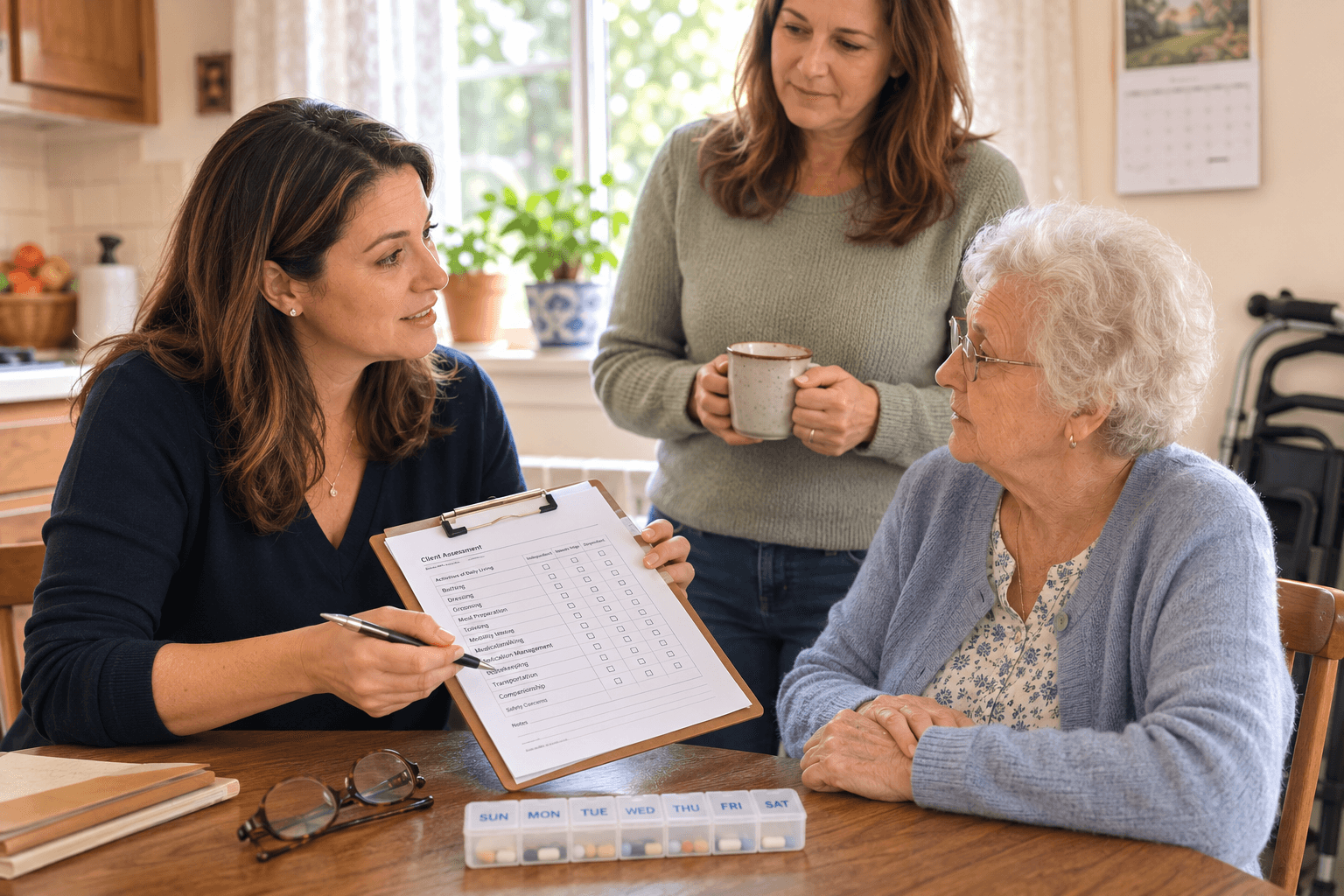
The in-home assessment is the moment everything becomes real. A family opens their door, shows you around, and shares what is happening with their loved one. You ask questions, observe the environment, take mental notes, and begin building a picture of what care will look like. It is one of the most human moments in the entire intake process.
Then you drive home and spend the next hour trying to reconstruct everything you just experienced into documentation. For most home care agencies, the assessment visit itself is handled well. It is what comes after that slows everything down. Writing up notes, drafting the care plan, updating the client record, and communicating next steps to the family can consume 30 to 45 minutes per visit, sometimes more.
You can multiply that across 10 to 15 assessments a month and you have a significant block of administrative time that is not generating revenue or building relationships. And the agencies that have started rethinking how intake documentation works from first call through care plan delivery are finding that the assessment step is where the biggest time savings are hiding.
Why Assessment Documentation Is So Time-Consuming
The challenge with in-home assessment documentation is not that it is difficult. It is that it is dense. A single visit generates a large volume of information across multiple categories: the client's health history and current condition, the home environment, mobility and ADL needs, family dynamics and preferences, schedule considerations, and care plan recommendations.
Capturing all of that accurately, in a format that is useful for care planning and compliant with your record-keeping requirements, takes time. When it is done from memory an hour after the visit, it is also imperfect. Details get softened or forgotten. Specifics that felt obvious in the moment are harder to articulate at a desk.
Most agency owners describe this part of the job as the part they like least: not because they dislike documentation, but because it pulls them away from the work they built the agency to do.
The Assessment Recording Difference
The single biggest shift agencies report in their documentation workflow is moving from memory-based notes to recorded assessments.
Recording an in-home assessment, with appropriate client consent, means the conversation itself becomes the source of truth. Nothing is reconstructed. Nothing is forgotten. The full context of what was said, how the family described the situation, the specific questions the client asked, all of it is preserved and available for review.
For agencies using AI-powered tools, the recording becomes the input for automated documentation. The system processes the conversation and generates a structured summary: key health and care needs, home environment observations, family preferences, and recommended care plan elements. The coordinator reviews, fills in anything the summary missed, and approves. What previously took 30 to 45 minutes of writing now takes five to ten minutes of review.
This is the moment most agency owners describe as the turning point in how they think about intake technology. It is not a marginal efficiency gain. It is a fundamentally different way of working that makes thorough, accurate documentation genuinely achievable without sacrificing the rest of the day to produce it.
What Good Assessment Documentation Actually Includes
Before optimizing the process, it helps to be clear about what a complete in-home assessment record should contain. For most non-medical home care agencies, a thorough assessment document covers:
Client profile and health background
Primary diagnosis or reason for seeking care
Medications and any relevant medical history
Cognitive status and any memory concerns
Mobility level and fall history
Activities of daily living (ADL) needs
Bathing, dressing, grooming, toileting
Meal preparation and dietary needs or restrictions
Housekeeping and errands
Transportation requirements
Home environment observations
Layout and accessibility considerations
Safety concerns or modifications needed
Pet or family members present in the home
Family and social context
Primary family contact and their involvement level
Other caregivers or support currently in place
Family concerns or priorities for care
Care plan recommendations
Proposed schedule and hours
Caregiver preferences or requirements
Next steps and timeline for care start
Getting all of this into a structured record consistently, across every assessment, is where manual documentation struggles. It depends on the individual coordinator's memory and habits rather than a reliable system.
How to Streamline Assessment Documentation Without Losing Quality
Record the visit, with consent
Most clients and families are comfortable with recording once it is explained clearly and professionally. Frame it as a quality and accuracy measure: you want to make sure their situation is documented completely so their care plan reflects everything that was discussed. Consent should be verbal and logged, or captured in writing as part of your intake process.
Use a structured assessment framework
Going into every visit with a consistent set of questions and observation categories ensures nothing important gets missed. A framework does not make the conversation feel scripted. It makes sure the coordinator covers what needs to be covered even in visits that take unexpected directions.
Let AI handle your first draft
For agencies using home care intake automation tools, the recording becomes the raw material for an AI-generated summary. That summary gives the coordinator a structured starting point rather than a blank page. Editing and approving a draft is significantly faster than building documentation from scratch, and it produces more consistent results across the team.
To understand how this fits into a broader intake workflow, read this post on building a faster path from client inquiry to signed care agreement.
Sync documentation to your client record immediately
Documentation that lives in a notepad or a separate file until someone enters it into the system is documentation that can get lost, duplicated, or forgotten. Platforms that sync assessment summaries directly to the client record eliminate the manual transfer step and keep every record current without additional effort.
The Compliance Dimension of Assessment Documentation
Assessment records are not just operational tools. They are protected health information. How they are stored, who can access them, and how they are transmitted all carry compliance implications under HIPAA.
This matters particularly for agencies using general-purpose recording tools, personal devices for assessment visits, or consumer apps for note-taking. None of these are inherently HIPAA compliant, and the fact that they are convenient does not reduce the risk they create. Before settling on any documentation tool, agencies should understand how it affects their HIPAA risk exposure across the full client record lifecycle.
A platform built for home care assessment documentation should offer encrypted storage, role-based access controls, and a signed Business Associate Agreement. These are not premium features. They are baseline requirements for handling client health information responsibly.
From Better Documentation to Better Care Plans
There is a quality argument here that goes beyond efficiency. When assessment documentation is thorough and accurate, care plans are better. Caregivers arrive for their first shift with a clear picture of the client's needs, preferences, and home environment. Families feel confident that what they shared during the assessment was actually heard and incorporated.
This connection between documentation quality and care quality is one of the clearest ways that administrative improvements translate into clinical and relational outcomes. An agency that consistently produces detailed, accurate assessment records is an agency that delivers more consistent care. That reputation compounds over time into referrals, renewals, and reviews.
For agencies thinking about how the broader business case for structured intake workflows ties into revenue and growth, this breakdown of what a home care agency can realistically earn helps frame where operational efficiency directly affects the bottom line.
Measuring the Impact of Faster Assessment Documentation
If you want to know whether changes to your assessment documentation process are making a difference, track these metrics before and after:
Time from assessment to completed care plan — The most direct measure of documentation speed
Assessment-to-client conversion rate — Faster documentation enables faster family communication, which affects conversion
Coordinator time spent on post-assessment admin — Track this honestly for two weeks and the number will likely surprise you
Documentation completeness rate — Are all required fields consistently filled in across every assessment record?
You can explore how these fit into a broader set of home care intake KPIs worth tracking to build a measurement system that shows you exactly where your process is strong and where it is leaking.
Turn Every Assessment Into a Complete Record in Minutes
Sage Care's built-in assessment recording and AI documentation tools give home care agencies a faster, more consistent way to handle post-visit paperwork. Record the visit, review the AI-generated summary, approve with one tap. What used to take 30 to 45 minutes takes under ten.
Sage Care is HIPAA-compliant and offers a 30-day free trial. Schedule a demo to see the assessment workflow in action.
FAQs
How does recording an in‑home assessment reduce paperwork?
Recording lets you capture the full visit once, then auto-generate summaries and care plan drafts instead of filling out multiple forms and retyping notes later.
What exactly should my assessment documentation include?
At minimum: home safety risks, ADLs/IADLs, routines, medical conditions, family expectations, service preferences, and clear next steps that feed directly into the care plan.
How does assessment documentation connect to my CRM and care plans?
The visit recording becomes structured notes in your CRM, which then populate care plan fields and follow-up tasks, so you are not copying the same details into different systems.
Why is assessment recording an “aha” moment in our data?
Agencies see that recorded assessments produce more complete, consistent documentation, higher conversion to care plans, and fewer lost or stalled leads in their CRM.
How does this tie into “From Click to Care Plan”?
The same workflow that logs web or phone inquiries (“click”) also logs the in‑home assessment, so recording → documentation → care plan all happen inside one connected intake system.