
Free Home Care Assessment Form Template
Free printable home care assessment form for non-medical agencies. Print and use in 45 minutes

Sage Care Editorial
Content & Communications Team
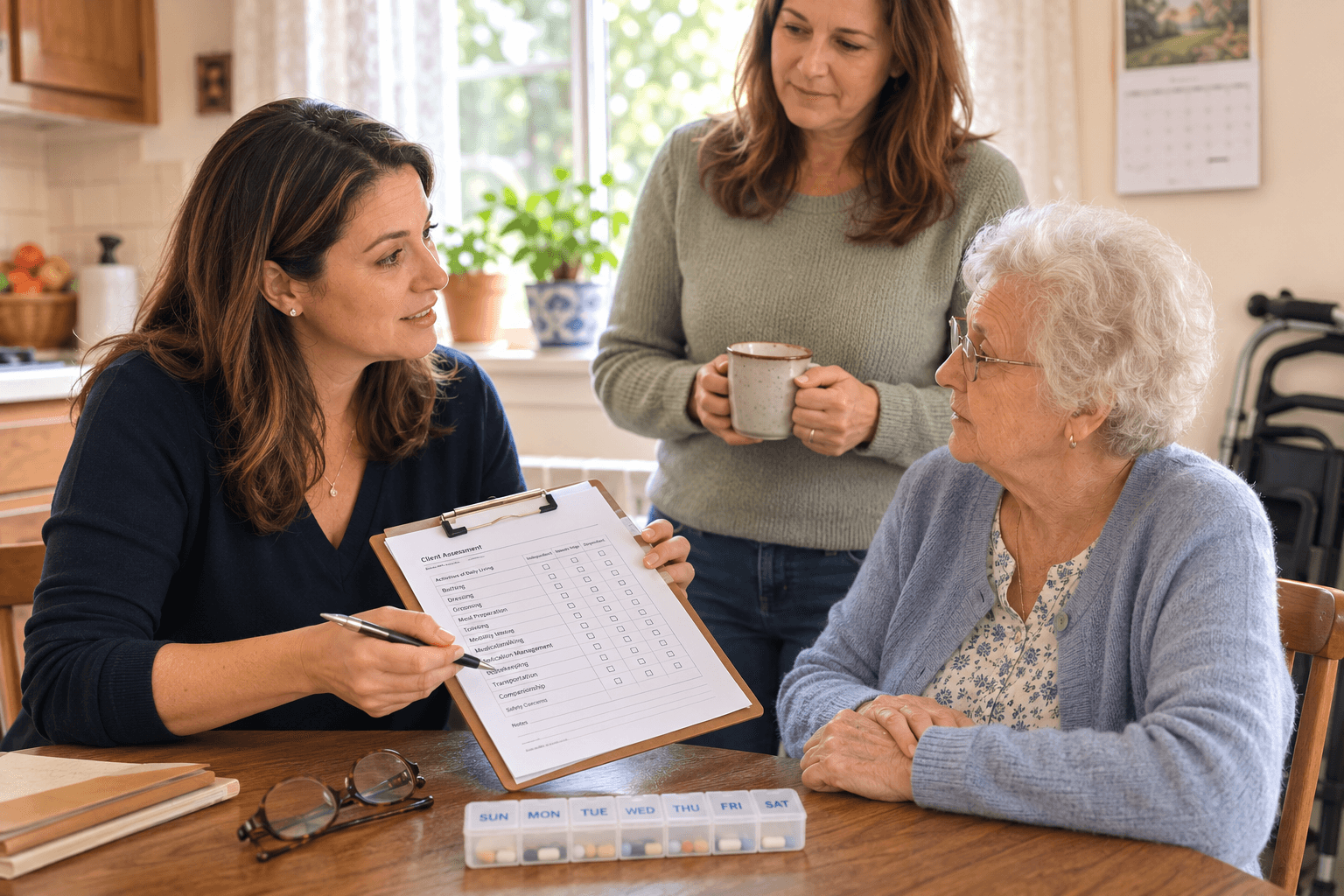
Download the printable PDF above, or use the inline form below to help streamline client assessments and ensure no information gets lost or omitted.
Looking for other forms? Check out our full set of home care form templates here.
Home Care Client Assessment Form
Non-medical home care. This form is for planning care and support services only. It is not a medical or skilled nursing assessment.
Date of assessment: __________________ Assessor name: __________________
1. Client Demographics
Field | Response |
Full name |
|
Preferred name |
|
Date of birth |
|
Gender |
|
Height |
|
Weight |
|
Primary language |
|
Lives with | [ ] Alone [ ] Spouse/partner [ ] Adult child [ ] Other family [ ] Roommate [ ] Other: __________ |
Home address |
|
Phone |
|
2. Emergency Contacts and Responsible Party
Emergency contact 1
Field | Response |
Name |
|
Relationship |
|
Phone |
|
Address |
|
Emergency contact 2
Field | Response |
Name |
|
Relationship |
|
Phone |
|
Address |
|
Responsible party (person who handles decisions or payment, if different from client)
Field | Response |
Name |
|
Relationship |
|
Phone |
|
| |
Has legal authority? | [ ] Power of Attorney [ ] Healthcare proxy [ ] Guardian [ ] None [ ] Unsure |
3. Medical Background
For care planning only. Record what the client or family reports. Do not diagnose.
Conditions and diagnoses (as reported by client or family)
Condition / diagnosis | Since (year, if known) | Notes |
|
|
|
|
|
|
|
|
|
|
|
|
Prognosis or expected changes (in the family’s words, if shared)
Allergies (food, medication, environmental)
Allergy | Reaction |
|
|
|
|
|
|
[ ] No known allergies
Current medications (copy exactly from labels or med list)
Medication | Dosage | Schedule (times of day) | Taken independently? |
|
|
| [ ] Yes [ ] No |
|
|
| [ ] Yes [ ] No |
|
|
| [ ] Yes [ ] No |
|
|
| [ ] Yes [ ] No |
|
|
| [ ] Yes [ ] No |
|
|
| [ ] Yes [ ] No |
Who currently manages medications? __________________________
4. Functional Limitations
Area | Status | Notes |
Ambulation (walking, mobility) | [ ] No limitation [ ] Uses aid [ ] Limited [ ] Unable |
|
Vision | [ ] No limitation [ ] Wears glasses [ ] Limited [ ] Legally blind |
|
Hearing | [ ] No limitation [ ] Uses hearing aid [ ] Limited [ ] Deaf |
|
Cognition (memory, orientation) | [ ] No limitation [ ] Mild concerns [ ] Moderate [ ] Significant |
|
Mobility aids in use: [ ] Cane [ ] Walker [ ] Wheelchair [ ] Rollator [ ] None [ ] Other: __________
5. Activities of Daily Living (ADLs)
Rate each based on what you observe and what the client tells you.
Activity | Independent | Requires Assistance | Dependent | Notes |
Ambulation and Transfer | [ ] | [ ] | [ ] |
|
Bathing | [ ] | [ ] | [ ] |
|
Dressing and Grooming | [ ] | [ ] | [ ] |
|
Toileting | [ ] | [ ] | [ ] |
|
Eating | [ ] | [ ] | [ ] |
|
6. Instrumental Activities of Daily Living (IADLs)
Activity | Independent | Requires Assistance | Dependent | Notes |
Medication Management | [ ] | [ ] | [ ] |
|
Preparing Meals | [ ] | [ ] | [ ] |
|
Housework | [ ] | [ ] | [ ] |
|
Laundry | [ ] | [ ] | [ ] |
|
Shopping | [ ] | [ ] | [ ] |
|
Transportation | [ ] | [ ] | [ ] |
|
Pet Care | [ ] | [ ] | [ ] |
|
7. Home Safety Observations
Item | Observation |
Stairs (inside or entry) | [ ] None [ ] Present, has railing [ ] Present, no railing Notes: __________ |
Bathroom hazards | [ ] Grab bars present [ ] No grab bars [ ] Slippery floor [ ] Raised toilet seat [ ] Shower chair Notes: __________ |
Lighting | [ ] Adequate [ ] Poor in some areas Notes: __________ |
Clutter or trip hazards | [ ] None [ ] Some [ ] Significant Notes: __________ |
Equipment in use | [ ] Hospital bed [ ] Lift [ ] Oxygen [ ] Commode [ ] None [ ] Other: __________ |
Smoke and CO detectors | [ ] Present [ ] Not seen [ ] Unsure |
Falls in the last 12 months | [ ] None [ ] 1 [ ] 2 to 3 [ ] 4 or more Details: __________ |
Other safety notes:
8. Caregiver Match Preferences
Mark whether each preference is Required or Preferred.
Preference | Detail | Required | Preferred |
Caregiver gender | [ ] Female [ ] Male [ ] No preference | [ ] | [ ] |
Smoking | [ ] Non-smoker only | [ ] | [ ] |
Comfortable with pets | [ ] Yes Pet type: __________ | [ ] | [ ] |
Language spoken | __________________ | [ ] | [ ] |
Dementia experience | [ ] Needed | [ ] | [ ] |
Other preferences:
9. Care Goals
In the client’s or family’s own words. Write what they say.
10. Proposed Schedule
Field | Response |
Days of the week | [ ] Mon [ ] Tue [ ] Wed [ ] Thu [ ] Fri [ ] Sat [ ] Sun |
Start time |
|
End time |
|
Hours per visit |
|
Total hours per week |
|
Preferred start date |
|
Notes on timing or flexibility:
11. Signatures
Role | Signature | Printed name | Date |
Assessor |
|
|
|
Client or responsible party |
|
|
|
How to Use This Form
This form is built to be filled out in one sitting during a first in-home visit, usually in about 45 minutes. Print it and bring a clipboard and two pens. You do not need to complete the sections in order. Most assessors start with demographics and emergency contacts while the client settles in, then move into the medical and daily living questions once there is a bit of rapport.
For the medical section, copy medications straight from the pill bottles or the client’s med list. Do not rely on memory, and do not correct or interpret what you see. Your job is to record, not to diagnose.
The ADL and IADL tables are the heart of the assessment. “Independent” means the person does the task safely on their own. “Requires Assistance” means they need help, standby support, or reminding. “Dependent” means someone else does it for them. Use the notes column freely, since that detail is what helps you match the right caregiver and build a realistic schedule.
Walk through the home for the safety section rather than asking from the couch. Look at the bathroom, the stairs, and the path the client takes most often.
Capture care goals in the family’s own words, even if they are informal. “I want Mom to stay in her house” tells you more than a checkbox.
Finish by reviewing the proposed schedule out loud and getting signatures. Keep the signed original in the client file and give the family a copy.
This form supports care planning and does not meet any specific state licensing, Medicaid, or accreditation requirement. Requirements vary by state, so check your local rules.


